Patient observed sterile treatment for medical infusions
Risks to transmit HIV through infusions
If the provider uses a needle, tube, and bag of saline (salt plus water) with or without medicine to infuse an HIV-positive patient and then, with no effort to clean, reuses them to infuse you, your risk to get HIV may be estimated as 3%-10% (see Table on Estimated risks in Blood-borne risks section). Some of this risk comes from traces of blood in the reused needle and some comes from traces of blood that can get in the reused tube and saline bag. Some risk may also come from adding medicine to the saline bag — the medicine may come from a contaminated multi-dose vial, or the syringe used to add the medicine may be reused and unsterilized.
POST can protect, but consider everything, not just the needle
| POST for infusions: To give you an infusion, the provider sticks a needle into a vein (usually in your arm), connects the needle to a tube, and connects the tube to a bottle hanging above you – so the fluid runs into you, rather than your blood running into the tube. The provider may add medicine to the saline. |
|
1. Avoid skin-piercing procedures
|
For outpatients who are conscious, infusions are almost never required. Most of what is infused – saline, glucose, and other fluids – can be given orally. Ask your provider if an oral alternative is available.
If an oral alternative is not available, such as for some antibiotics, injections are usually possible, and are safer than infusions.
|
| 2. Use new disposable instruments |
Use new disposables only. Everything that is required for an infusion (needle, tubes, bottle of saline) is low cost.
If the provider cooperates: Make sure that the syringe used to add medicine to the saline bottle is new (opened in front of you) and that the medicine comes from a single-dose vial or multi-dose vial opened in front of you.
If the provider cooperates, you can maybe buy and bring all these items.
|
| 3. You sterilize the instruments |
This is not relevant. Avoid, or use disposables. |
| 4. Ask providers how they sterilize instruments |
This is not relevant. Avoid, or use disposables. |
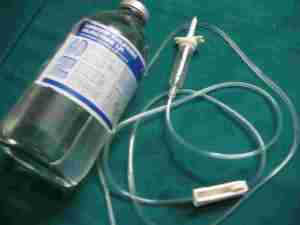
Infusion set with bottle
Additional information on infusions
Infusions are far too common: Many providers give infusions to outpatients during short clinic visits, or even at home. Most infusions are unnecessary. If you are conscious and can hold things down (not vomiting everything you take orally), you are better off taking fluids and medicines orally. Most infusions deliver nothing more than saline (salt plus water) or glucose (sugar plus water) for weakness or other minor conditions. For patients with severe diarrhoea, especially from cholera, infusions deliver oral rehydration solution (salt, sugar, and water) – this, too, is better taken orally if you can hold it down.

 Bloodborne HIV: Don't Get Stuck!