Bloodborne HIV: Don't Get Stuck!

Protect yourself from bloodborne HIV during healthcare and cosmetic services

10 years later: Continuing unethical and incompetent behavior by medical professionals coincides with conflict of interest, leading to millions of unexplained HIV infections


Health care professionals in African ministries of health, the World Health Organization (WHO), donor organizations, and foreign universities participating in HIV-related research in Africa know the proper response to unexpected HIV infections (eg, in children with HIV-negative mothers, in spouses with one lifetime HIV-negative sex partner). That response is to find the source of the infection by tracing and testing others who attended suspected hospitals and clinics, and thereby to identify and correct unsafe practices to protect other patients. There have been no such investigations of unexpected HIV infections in any country in sub-Saharan Africa.

Health care professionals are ethically obligated to give patients accurate information about risks. The World Medical Association’s Declaration of Lisbon on the Rights of the Patient[1] states: “A mentally competent adult patient has the right to give or withhold consent to any diagnostic procedure or therapy. The patient has the right to the information necessary to make his/her decisions…” and “Every person has the right to health education that will assist him/her in making informed choices about personal health and about the available health services.”

Medical researchers trying to find what is different about HIV transmission in Africa that could explain the world’s worst HIV epidemics know that the best way to do so is to trace and test sex and blood contacts when someone shows up with a new or unexplained infection. Unfortunately, medical researchers (who are also health care professionals) have been reticent to find their colleagues’ contribution to Africa’s HIV epidemics. For example, 44 studies[2] that followed more than 120,000 adults in Africa and observed more than 4,000 new HIV infections linked only 186 (4.6%) of those infections to HIV-positive sex partners, all of which were spouses the study had been following all along. No study traced and tested any sex partner (spouse or other) not already included and followed in the study. No study traced blood contacts, and few studies reported any information about blood risks. Despite lack of evidence (avoided and ignored evidence) all studies assumed infections came from sex. (These 44 studies were randomized controlled trials of interventions to prevent HIV in African adults.)

For 30 years, medical professionals have accused HIV-positive Africans of careless or immoral sexual behavior. But if one looks for what is different in Africa vs. the US and Europe, what jumps out is not sexual misbehavior but rather unethical, immoral, and incompetent behavior by health care professionals: not investigating unexpected HIV infections; not warning the public about unsafe health care; and mismanaging research so as not to find risks for HIV.

Ten years ago, on 14 March 2003, WHO held a one-day meeting to discuss the role of unsafe medical injections in Africa’s HIV/AIDS epidemics. WHO staff arranged the meeting after a series of articles[3][4][5] in the International Journal of STD & AIDS during 2002-03 called attention to decades of overlooked evidence that unsafe health care infected Africans with HIV. The 20 invited attendees[6] included three co-authors of these articles (Brody, Gisselquist, and Potterat).

WHO staff managed the meeting as part of a continuing cover-up of hospitals’ and clinics’ contribution to Africa’s HIV epidemics. The meeting was closed to the public. A first press release, prepared by WHO staff in the days before the meeting and released before it ended, misleadingly claimed:[7] “An expert group has reaffirmed that unsafe sexual practices are responsible for the vast majority of HIV infections in sub-Saharan Africa…”

Later that year, WHO’s meeting summary[8] acknowledged that “No consensus emerged from the conference” on whether “sexual transmission was responsible for the large majority of HIV infections.” The summary also noted “universal agreement…that better data on the possible role of unsafe injections, and other health care practices, in HIV transmission are needed to more definitively determine their role in HIV transmission in sub-Saharan Africa.”

Unfortunately, the events of the last 10 years show a continuing unwillingness on the part of too many health care professionals to do what is needed to find and stop HIV transmission through unsafe health care in Africa.


[1] World Medical Association. 2005. Declaration of Lisbon on the Rights of the Patient. Ferney-Voltaire, France: WMA. Available at: http://www.wma.net/en/30publications/10policies/l4/ (accessed 18 August 2012).

[3] Gisselquist D, Rothenberg R, Potterat JJ, Drucker E. HIV infections in sub-Saharan Africa not explained by sexual or vertical transmission. By: Int J STD AIDS 2002; 13: 657-666. Available at: http://www.robertogiraldo.com/reference/Gisselquist_TransmissionIsNotSexual.pdf

[5] Gisselquist D, Potterat JJ, Brody S, Vachon F, Let it be sexual: how health care transmission of AIDS in Africa was ignored. Int J STD AIDS 2003; 14: 148-161. Available at: http://www.cirp.org/library/disease/HIV/gisselquist1/gisselquist1.pdf

[6] WHO. Unsafe injection practices and HIV Infection. Meeting summary (14 March 2003 meeting, undated summary posted by WHO later in 2003). Available at: http://www.who.int/hiv/strategic/mt14303/en/index.html (accessed 6 January 2013).

[7] WHO. Expert group stresses that unsafe sex is primary mode of transmission of HIV in Africa. Media Center statement 14 March 2003. Available at: http://www.who.int/mediacentre/news/statements/2003/statement5/en/index.html (accessed 6 January 2013).

[8] WHO. Unsafe injection practices and HIV Infection. Meeting summary (14 March 2003 meeting, undated summary posted by WHO later in 2003). Available at: http://www.who.int/hiv/strategic/mt14303/en/index.html (accessed 6 January 2013).

WHO’s and UNAIDS’ response: If there’s a problem, we warned Africans


On 15 October, three managers of dontgetstuck along with five other experts sent an Open Letter to the heads of WHO, UNAIDS, and World Bank, challenging them to warn and protect Africans from HIV through health care. There is no indication that Chan, Sidibe or Kim read the letter. The only response we have received is from De Lay of UNAIDS and Nakatani of WHO (see below).

The response, which falls short of what WHO and UNAIDS could do under the circumstances, leads to several questions:

Question 1: If the evidence we presented (16%-31% of HIV-positive children with HIV-negative mothers) had come from Europe, would WHO and UNAIDS let it go by without recommending urgent actions to correct whatever happened to infect children?

Even asking this question brings the realization that governments and populations in Europe would not wait to see what WHO or UNAIDS said about the situation – they would insist on investigations to find how children had been infected and thereby to ensure that their health care is safe. We can see such investigations in Russia under Gorbachev, Romania under Ceausescu, Libya under Kaddafi, Kazakhstan, Kyrgyzstan, and Uzbekistan – all of which countries acted without waiting for WHO advice or assistance.

Question 2: Since WHO and UNAIDS have not recommended a specific response to evidence of large numbers of HIV-positive African children with HIV-negative mothers, who if anyone is going to respond to protect African children?

De Lay and Nakatani say that WHO and UNAIDS have warned African governments about unsafe health care, in effect putting the onus on Africans to respond to the evidence in the Open Letter. Whether the onus belongs there or not, it seems clear that WHO and UNAIDS are not ready to do more to protect African children from unsafe health care. Will African governments step up, or will they take the low road, like WHO and UNAIDS, letting things go on and on?

[See also Simon Collery’s comments on WHO’s and UNAIDS’ reply, with information about health care conditions in Africa.]

WHO’s and UNAIDS’ letter responding to Open Letter

23 October 2012

Dear Dr Gisselquist and colleagues,

Thank you for the open letter sent to Mr Sidibe, Dr Chan and Dr Kim on 15 October, 2012. We recognize that unsafe injections, skin piercing, blood transfusions and surgical procedures can contribute to HIV transmission, and advise countries that an effective HIV response should take into account all available data on modes of transmission in the design and implementation of their response.

As part of our commitment to reducing HIV incidence and new HIV infections, both the World Health Organization (WHO) and UNAIDS have produced guidance with unsafe skin-piercing procedures. UNAIDS Prevention Policy Paper, and the WHO Global Health Sector Strategy on HIV/AIDS, 2011-2015 make explicit reference to the importance of preventing unsafe injections, surgical practices and blood transfusions. WHO and UNAIDS advise countries to scale up proven and cost-effective strategies, policies and programmes that are tailored to their actual HIV epidemic and its social, economic and health system context (Know Your Epidemic/Know Your Response).

Recently, WHO’s Director-General, Dr Margaret Chan called for action on injection safety. Since this call, a cross-departmental working group has been created to develop a policy document and implementation plan on the safety of all therapeutic injections.

Thank you for raising these issues in the letter and for your efforts in the fight against HIV.

Best regards,

Paul De Lay, Deputy Executive Director, Programme, UNAIDS
Dr Hiroki Nakatani, Assistant-Director General, HIV/AIDS, Tuberculosis, Malaria and Neglected Tropical Diseases, WHO

An open letter to Michel Sidibé, Executive Director of UNAIDS, Margaret Chan, Director-General of WHO, and Jim Kim, President of the World Bank


Dear Colleagues,

We commend your organizations’ efforts to treat people infected with HIV and to prevent mother-to-child HIV transmission. Such efforts should be continued and expanded. Unfortunately, that will not be enough to stop almost two million Africans from contracting HIV each year.

This letter is spurred by results released in September 2012 from a national survey in Uganda in 2011. We call your attention to one of the findings: 16% of HIV infected children age 0-5 years had HIV-negative mothers, among children with tested mothers. This is the 4th national survey in Africa to match the HIV status of children and mothers. In the three previous surveys, Uganda in 2004-05, Swaziland in 2006-07, and Mozambique in 2009, 16%-31% of HIV-positive children had HIV-negative mothers (see survey reports at: http://www.measuredhs.com/countries/: see also analyses of raw data for Mozambique and Swaziland at: Int J STD AIDS 2009, 20:852-7; and http://www.webmedcentral.com/article_view/2206).

To help stop HIV transmission through skin-piercing procedures in health care and cosmetic services, we urge your organizations to tell the African public what UNAIDS and WHO already tell UN, including World Bank, employees: “unsafe blood collection and transfusion practices and the use of contaminated syringes account for a notable share of new infections” (p. 9 in: http://whqlibdoc.who.int/unaids/2004/9291733717_eng.pdf), and “avoid having injections unless they are absolutely necessary… Avoid tattooing and ear piercing. Avoid any procedures that pierce the skin, such as acupuncture and dental work, unless they are genuinely necessary. Before submitting to any treatment that may give an entry point to HIV, ask whether the instruments to be used have been properly sterilized” (p. 23 in: http://whqlibdoc.who.int/hq/1991/WHO_GPA_DIR_91.9.pdf).

Warning the public about blood-borne risks for HIV not only allows people to avoid risks, but also empowers and motivates the public to hold their health caretakers (both formal and informal), providers of cosmetic procedures, and ministries of health to a high standard of safety.

Available evidence suggests that warning people about blood-borne risks could have a significant impact on HIV epidemics. During 2003-07, national surveys in 16 African countries asked people how to prevent HIV. In countries where more people said that avoiding contaminated instruments such as razor blades was a way to prevent HIV infection, people were less likely to be infected (see Figure).

Figure: Percent of adults with HIV vs. percent aware of blood-borne risks

Percentage of adults with HIV vs. percentage aware of blood-to-blood risks

Percentage of adults with HIV vs. percentage aware of blood-to-blood risks

Source: For each country, the percent of adults who say “avoid sharing razors/blades” is the average of percents for men and women from 16 surveys, excluding adults who were not aware of HIV or had been previously tested for HIV, as reported in: J Infect Dev Ctries 2011; 5: 182-198, http://www.jidc.org/index.php/journal/article/view/21444987/518. Percents of adults with HIV (except for DRC and Ethiopia) are for 2009 from: UNAIDS, Report on the Global Epidemic 2010; for DRC and Ethiopia these are for 2007 and 2005, respectively, from national surveys available at: http://www.measuredhs.com/countries/.

The World Medical Association’s Declaration of Lisbon on the Rights of the Patient (http://www.wma.net/en/30publications/10policies/l4/) avers that each patient has “the right to the information necessary to make his/her decisions.” We ask you to ensure that your organizations adhere to this principle by emphasizing blood-borne risks in HIV prevention education and by making safety a priority in all programming with health care and cosmetic service providers and institutions.

Faithfully,

Dr. David Gisselquist dontgetstuck   collective, www.dontgetstuck.wordpress.com
John J.   Potterat Independent   STD/HIV consultant, jjpotterat@earthlink.net
Dr. Deena   Class Global health   & development consultant
Simon   Collery Dontgetstuck   collective, www.dontgetstuck.wordpress.com
Dr.   Joseph Sonnabend JSonnabend@btinternet.com
Dr.   Janet S. St. Lawrence, Professor   Emerita, Mississippi State University
Dr.   Mariette Correa Associate   Professor, Tata Institute of Social Sciences, Guwahati, India
Dr.   Wallace Dinsmore Consulting   Physician, Royal Victoria Hospital, Belfast
Dr.   François Vachon Emeritus Professor, Denis Diderot University, Paris,   France

Break the silence: Stop HIV transmission through health care and cosmetic procedures (part 3 of 3)


[this is the 3rd of 3 parts; click here to get the complete paper]

6.         Wherever governments investigate unexpected HIV infections, HIV concentrates in MSMs and IDUs

An unexpected infection – for example, in a child with an HIV-negative mother or a woman with one lifetime HIV-negative sex partner – is a warning that people may be getting infections from an unknown source. Many governments outside Africa have reacted to unexpected infections by investigations – tracing and testing patients who attended specific hospitals or clinics suspected to be the source of the unexpected HIV infection (Table). Such investigations are able to stop further damage by finding others who are infected and thereby identifying the procedures and errors that led to infections. No country in which the government investigated unexpected HIV infections has a generalized epidemic.

Table: Investigated HIV outbreaks from unsafe health care procedures (outbreaks with 100 or more infections)

Country,   year of outbreak Who   was infected Number   of cases
Mexico, circa   1986[1] Blood   and plasma sellers 281
Russia, Elista, 1988-89[2] Inpatient   children >260
Romania, 1987-1992[3] Children ~10,000
India, Mumbai,   1988[4] Blood   and plasma sellers ~172
China, 1990-95[5] Blood   and plasma sellers ~100,000
Libya, 1997-99[6] Inpatient   and outpatient children >400
Kazakhstan, 2006[7] Inpatient   children >140
Kyrgyzstan,   2007[8] Inpatient   children >140
Uzbekistan,   2008[9] Inpatient   children >140

For example, in 1989, doctors in a Romanian hospital found several children with HIV but with HIV-negative mothers. In response, doctors and later the government tested thousands of children in 1989-91, found more than 1,000 with HIV, and determined that most infections came from injections. Investigations alerted the public and providers to demand and ensure safe care. Currently, less than 0.1% (1 in 1,000) of Romanians are infected – one of the lowest levels in the world.

In contrast, even though unexpected infections are common in sub-Saharan Africa, no African government has investigated any unexpected HIV infection by tracing and testing other patients who attended a suspected clinic or hospital. The failure to investigate is like smelling smoke, but then going back to sleep and letting the house burn down. Here are some unexpected infections that African governments could have and should have investigated, but didn’t:

Unexplained infections are also common in adults with no sexual risks, including virgin men and women. For example:

7.         Wherever governments react to stop unsafe health care, HIV concentrates in MSM and IDUs

In the US and Europe, governments arrange several mechanisms to find and stop reuse of unsterilized skin-piercing instruments in health care. These mechanisms include regulations describing acceptable practices, licenses, inspections, and courts that allow patients to sue for damages. When someone reports unsafe procedures in a health facility, inspectors visit the facility. If the error is considered dangerous to pass infections among patients, governments may trace and test patients.

In the US and Europe, it’s not only governments that are vigilant about risks to get HIV from blood, so is the general public. For example, if a participant in a sporting contest gets a bleeding cut, referees send him or her to the sidelines. The player is not allowed to return to the game until his or her cut has been covered.

In contrast to what happens in the US and Europe, unsafe procedures are common and tolerated in Africa. As already reported at the beginning of this note, many health care facilities lack equipment to sterilize instruments, and many people accept cosmetic services in public places with unsterilized instruments that could pierce their skin.

Break the silence

Health care professionals from Geneva to African ministries of health to hospitals and clinics in towns and cities across Africa have largely ignored HIV transmission through health care. As far as I can see, their silence comes at least in part from not wanting or not knowing how to tell the public there is a problem. Because health care professionals have not wanted to talk about the problem, it’s up to the public at risk to break the silence. Here are some suggestions about what people can do to break the silence and thereby to protect themselves and others.

Avoid contaminated instruments: People who are aware of blood-borne risks can avoid contaminated skin-piercing instruments. A general strategy to do so boils down to four options: avoid the procedure, use disposable instruments, patients/clients sterilize instruments, or talk with providers to ensure they sterilize instruments. Further suggestions about this strategy are available at: https://dontgetstuck.wordpress.com, with pages on injections, tattooing, etc.

Talk about unexpected infections: Individual efforts to avoid unsterilized instruments do not always work. People may not feel comfortable asking a doctor or nurse if instruments have been sterilized. Moreover, in a lot of situations – such as in an emergency – people have little or no chance to control the instruments used on them. In other words, to be really safe from blood-borne HIV people need to ensure that hospitals and clinics in their communities are not making careless errors.

Investigations are the key to finding and stopping errors. People who are aware of risk can help to lay the groundwork for investigations by talking with others in their communities about risks to get HIV from skin-piercing procedures. Then, whenever an unexpected infection gets recognized in the community, more people will be aware of their own risk, and could work together to push for investigations through political leaders, the media, and courts.

The objective of an investigation should not be to punish anyone or to collect damages for victims but rather to find others who have been infected and thereby to find and stop errors. Many African governments already offer free treatment for HIV, so victims can get care. During investigations, health staff should be assured they will not be blamed or punished for errors.

HIV prevention programs aimed exclusively at sexual transmission have failed to stop HIV in Africa – they do not protect people from all risks. People at risk can do something different to get different results: beware unsterile skin-piercing instruments, and break the silence to urge their communities and governments to address blood-borne and not only sexual risks.


[1] Avila C, et al; AIDS 1989; 3: 631-3.

[2] Bobkov A, et al; AIDS 1994; 8: 619-624. Pokrovskii VV, et al. Zh Microbiol Epidemiol Immunobiol 1990, 4: 17-23. Pokrovsky VV; 8th Int Conf AIDS, Amsterdam 19-24 July 1992; abstract PoC 4138. Sauhat SR, et al; 8th Int Conf AIDS, Amsterdam 19-24 July 1992, abstract PoC 4288.

[3] Patrascu IV, Dumitrescu O; AIDS Res Hum Retroviruses 1993; 9: 99-104. Apetrei C, et al. AIDS Res Hum Retroviruses 1997; 13: 363-5. Drucker E, et al; In Sande MA, et al; Global HIV/AIDS Medicine; Philadelphia: Saunders, 2007.

[4] Bhimani GV, Gilada IS; 8th Int Conf AIDS, Amsterdam 19-24 July 1992; abstract MoC00937.

[5] Wu Z, et al; Health Policy Plan 2001; 16: 41-6. Wu Z, et al; Lancet 1995; 346: 61-2. UNAIDS, 2005 Update on the HIV/AIDS epidemic and response in China; WHO, 2006.

[6] Visco-Comandini U, et al. AIDS Res Hum Retroviruses 2002; 18: 727-32. de Oliviera T, et al; Nature 2006; 444: 836-7.

[7] Kazakhstan: more HIV-infected children…; RadioFreeEurope/RadioLiberty, 3 October 2007. Available at: http://uqconnect.net/signfiles/Archives/SIGN-POST00405.txt (accessed 10 October 2007). In the courts: Health workers sentenced…Kaisernetwork.org, 2 January 2008. Available at: http://www.kaisernetwork.org/daily_reports/rep_index.cfm?hint=1&DR_ID=49564 (accessed 27 March 2009).

[8] Shersen D; Kyrgyzstan: Officials grapple…; EurasiaNet, 30 October 2007. Available at: http://uqconnect.net/signfiles/Archives/SIGN-POST00419.txt (accessed 1 November 2007). Thome C, et al; Lancet Infect Dis 2010; 10: 479-488. AP/Houston Chronicle examines HIV outbreak…; Kaisernetwork.org, 11 April 2008. Available at: http://www.kaisernetwork.org/daily_reports/rep_index.cfm?hint=1&DR_ID=51472 (accessed 27 March 2009).

[9] Thome C, et al; Lancet Infect Dis 2010; 10: 479-488.

[10] Mann JM, Francis H, Davachi F, et al. ‘Risk factors for human immunodeficiency virus seropositivity among children 1-24 months old in Kinshasa, Zaire’, Lancet, 1986, ii: 654-7.

[11] Lepage P, Van de Perre P, Carael M, et al. ‘Are medical injections a risk factor for HIV in children?’, Lancet, 1986, ii: 1103-4.

[12] Lepage P, Van de Perre P. Nosocomial transmission of HIV in Africa: What tribute is paid to contaminated blood transfusions and medical injections? Infect Control Hosp Epidemiol 1988, 9: 200-3.

[13] Hitimana D, Luo-Mutti C, Madraa B, et al. ‘A multicentre matched case control study of possible nosocomial HIV-1 transmission in infants and children in developing countries’, 9th Int Conf AIDS, Berlin 6-11 June 1993. Abstract no. WS-C13-2. Available at: http://www.aegis.com/aidsline/1993/nov/M93B3075.html (accessed 9 September 2007).

[14]Global Programme on AIDS. 1992-1993 Progress Report, Global Programme on AIDS. Geneva: WHO, 1993. p. 85.

[15] ORC Macro. Uganda HIV/AIDS Sero-Behavioural Survey 2004-05. ORC Macro: Calverton, Maryland, 2006. Available at: at http://www.measuredhs.com/what-we-do/survey/survey-display-224.cfm (accessed 21 September 2012).

[16] Ministry of Health, Kampala. Uganda AIDS Indicator Survey 2011. Calverton: ICF International, 2012. Available at: http://www.measuredhs.com/pubs/pdf/AIS10/AIS10.pdf (accessed 22 September 2012).

[17] Okinyi M, Brewer DD, Potterat JJ (2009) Horizontally acquired HIV infection in Kenyan and Swazi children. Int J STD AIDS 20: 852-857. Summary data available at: http://www.ncbi.nlm.nih.gov/pubmed/19948900 (accessed 8 July 2011).

[18] See pp. 177-181 in: Instituto Nacional de Saúde (INS), Instituto Nacional de Estatística (INE), e ICF Macro. 2010. Inquérito Nacional de Prevalência, Riscos Comportamentais e Informação sobre o HIV e SIDA em Moçambique 2009. Calverton, Maryland, EUA: INS, INE e ICF Macro. Available at: http://measuredhs.com/publications/publication-AIS8-AIS-Final-Reports.cfm (accessed 17 October 2012).

[19] See Table 7.5 in:  Centre National de la Statistique et des Études Économiques (CNSEE). Enquête de Séroprévalence et sur les Indicateurs du Sida du Congo (ESISC-I) 2009. Brazzaville: CNSEE, 2009. Available at: http://www.measuredhs.com/pubs/pdf/AIS7/AIS7.pdf (accessed 8 July 2011).

[20] Ministry of Health, Kampala. Uganda AIDS Indicator Survey 2011. Calverton: ICF International, 2012. Available at: http://www.measuredhs.com/pubs/pdf/AIS10/AIS10.pdf (accessed 22 September 2012).

Break the silence: Stop HIV transmission through health care and cosmetic procedures (part 2 of 3)


[this is the 2nd of 3 parts; click here to get the complete paper]

3.         In African countries where more people are aware of blood-borne risks, fewer people have HIV

During 2003-07, national surveys in 16 African countries asked people how to prevent HIV. In these surveys, the percent of adults who mentioned “avoid sharing razors/blades” as a way to prevent HIV ranged from 10% in Swaziland to almost 50% in Niger and Ethiopia. In five countries where less than 15% of adults recognized contaminated razors or blades as risks for HIV (Kenya, Lesotho, Swaziland, Tanzania, and Zimbabwe) the percentages of adults with HIV ranged from 5.6% to 26%. On the other hand, in six countries where at least 30% mentioned razors or blades (Democratic Republic of Congo [DRC], Ethiopia, Ghana, Niger, Rwanda, and Senegal) only 0.8% to 2.9% of adults were HIV-positive (Figure).

Figure: Percentages of adults with HIV vs. percentages aware of blood-borne risks

Percentage of adults with HIV vs. percentage aware of blood-to-blood risks

Percentage of adults with HIV vs. percentage aware of blood-to-blood risks

Note: the equation for the correlation is y = 20.2 – 0.53x. Source: For each country, the percent who say “avoiding sharing razors/blades” is the average of percents for men and women, excluding those not aware of HIV or who had been previously tested for HIV, from: Brewer DD. Knowledge of blood-borne transmission risk is inversely associated with HIV infection in sub-Saharan Africa. J Infect Dev Ctries 2011; 5: 182-198. Available at: http://jidc.org/index.php/journal/article/view/1308/518 (accessed 7 July 2011). Percentages of adults with HIV (except for DRC and Ethiopia) are for 2009 from: UNAIDS Report on the Global Epidemic 2010, available at: http://www.unaids.org/globalreport/Global_report.htm (accessed 4 July 2011); for DRC and Ethiopia these percentages are for 2007 and 2005, respectively, from national surveys available at: http://www.measuredhs.com/countries/.

4.         The best available evidence from Africa says that sex accounts for less than half of HIV infections in adults

During 1987-2011, 44 studies in Africa tested interventions to protect adults from HIV and reported their results. These 44 studies followed a total of more than 120,000 adults and observed a total of 4,029 new infections.[1] In most studies, the intervention failed – it had little or no impact on how fast people got HIV. But even though most interventions failed, these studies nevertheless provide some insights into how and why so many Africans are getting HIV.

The surest way to say how many of these 4,029 infections came from sex is to trace and test sexual partners; then, if any partners have HIV, sequence it to see if it matches HIV from the new infection. Only 4 of 44 studies did so, tracing a total of only 186 (4.6%) of 4,029 infections to sexual partners with similar HIV. Thus, according to these best criteria, we don’t know the sources of the other 95.4% of infections.

The second best way to say how many of these infections came from sex is to see how fast people with sexual risks got HIV compared to people with no sexual risks. Five of the 44 studies report rates of new HIV infections in men and/or women who did and did not report any possible sexual exposure to HIV. Here’s what they found:

  • In a study among men in South Africa in 2002-05,[2] men who reported no sex partner or 100% condom use (ie, no possible sexual exposure to HIV) got HIV at the rate of 1.11% per year compared to 1.86% for men who reported possible sexual exposure (at least one sex partner and less than 100% condom use). Having reported sexual exposures increased risk by a factor of 1.7 (= 1.86/1.11) times.
  • In a similar study among men in Uganda in 2003-06,[3] men who reported no partner or 100% condom use got HIV at the rate of 0.72% per year vs. 1.17% per year for men who reported one or more sex partners and less than 100% condom use. Having reported sexual exposures increased risk by a factor of 1.6 (= 1.17/0.72) times.
  • In a trial among women in South Africa reported in 2011, 1 (20%) of 5 women who reported no sex partners during the trial got HIV compared to 97 (11%) of 884 women who reported one or more sex partners. Having reported sexual exposures reduced risk by a factor of 0.55 (= 11/20) times.[4]
  • In a trial among men and women in Zimbabwe in 1998-2003, reporting one or more vs. no sex partners over a period of 3 years increased risk to get HIV by a factor of only 1.3 among women, and by a factor of 2.5 among men.
  • In a trial in Uganda in 1994-98,[5][6] men and women who reported one or more sex partners over 2 years got HIV 2.7 times faster than men and women who reported no sex partners.

Combining information from all five studies, the median (middle) impact of reported sexual risk on an adult’s rate to get HIV was 1.65. This result – that possible sexual exposure to HIV fell far short of doubling his or her risk to get HIV – suggests that sex accounts for far less than half of new HIV infections among adults.

Faced with such evidence, study teams supposed that participants lied about their sexual behavior and continued to aver that most HIV came from sex. It’s also notable that study teams for most trials – 39 out of 44 – did not say how many people with new HIV infections reported no possible sexual exposures to HIV, even though most studies collected information on numbers of partners. By disbelieving and withholding evidence, study teams are in effect saying that evidence is not necessary – that they know without and even despite evidence that almost all HIV infections in Africa come from sex.

5.         Many studies in Africa find HIV infections best explained by blood contacts

In 2001, UNAIDS hired Nicole Seguy to review evidence linking injections to HIV. Compiling data from all available studies that had followed HIV-negative adults to find new infections, and that had asked about and reported injections, she concluded: “contaminated injections may cause between 12% and 33% of new HIV infections” in Africa.[7]

Seven of the 44 trials mentioned above report information on blood exposures for adults with new infections, including:

Aside from these trials, a lot of other evidence links HIV to injections and other skin-piercing risks, for example:

Much more evidence is available at: https://dontgetstuck.wordpress.com; in a history of AIDS in Africa at: https://sites.google.com/site/davidgisselquist/pointstoconsider; in selected papers by Gisselquist at: https://sites.google.com/site/davidgisselquist/selected-articles; and in many of Devon Brewer’s recent papers at:  http://www.interscientific.net/pubs.html.


[1] Gisselquist D. Randomized controlled trials for HIV/AIDS prevention among men and women in Africa: untraced infections, unasked questions, and unreported data. SSRN 2011. Available at: http://ssrn.com/abstract=1940999 (accessed 18 September 2012).

[2] Auvert B, Taljaard D, Lagarde E, Sobngwi-Tambekou J, Sitta R, Puren A. Randomized, controlled intervention trial of male circumcision for reduction of HIV infection risk: the ANRS 1265 trial. PLoS Med 2005; 2(11): e298. Available at: http://www.ncbi.nlm.nih.gov/pmc/articles/PMC1262556/pdf/pmed.0020298.pdf  (accessed 15 September 2012).

[3] Gray RH, Kigozi G, Serwadda D, et al. Male circumcision for HIV prevention in men in Rakai, Uganda: a randomized trial. Lancet 2007; 369: 657-666.

[4] Karim QA, Karim SSA, Frolich JA, et al. Effectiveness and safety of tenofovir gel, an antiviral microbicide, for the prevention of HIV infection in women. Science 2010; 329: 1168-1174. Available at: http://www.ncbi.nlm.nih.gov/pmc/articles/PMC3001187/ (accessed 15 September 2012).

[5] Ahmed S, Lutalo T, Wawer M, et al. HIV incidence and sexually transmitted disease prevalence associated with condom use: a population study in Rakai, Uganda. AIDS 2001; 15: 2171-2179.

[6] Wawer MJ, Sewankambo NK, Serwadda D, et al. Control of sexually transmitted diseases for AIDS prevention in Uganda: a randomized community trial. Lancet 1999; 353: 525-535.

[7] Randerson J. WHO accused of huge HIV blunder. New Scientist, 6 December 2003, 180 (2424): 8-9.

[8] Watson-Jones D, Baisley K, Weiss HA, et al. Risk factors for HIV incidence in women participating in an HSV suppressive treatment trial in Tanzania. AIDS 2009; 23: 415-422.

[9] Auvert B, Taljaard D, Lagarde E, Sobngwi-Tambekou J, Sitta R, Puren A. Randomized, controlled intervention trial of male circumcision for reduction of HIV infection risk: the ANRS 1265 trial. PLoS Med 2005; 2(11): e298. Available at: http://www.ncbi.nlm.nih.gov/pmc/articles/PMC1262556/pdf/pmed.0020298.pdf  (accessed 15 September 2012).

[10] Auvert B, Sobngwi-Tambekou J, Taljaard D, Lagarde E, Puren A (2006) Authors’ Reply. PLoS Med 3(1): e67. Available at: http://www.plosmedicine.org/article/info%3Adoi%2F10.1371%2Fjournal.pmed.0030067 (accessed 15 October 2012).

Auvert B, Taljaard D, Lagarde E, Sobngwi-Tambekou J, Sitta R, Puren A. Randomized, controlled intervention trial of male circumcision for reduction of HIV infection risk: the ANRS 1265 trial. PLoS Med 2005; 2(11): e298.

[11] Whitworth JA, Birao S, Shafer LA, et al. ‘HIV incidence and recent injections among adults in rural southwestern Uganda’, AIDS, 2007, 21: 1056-8.

[12] The 10 countries are: Cameroon, Ethiopia Ghana, Guinea, Kenya, Lesotho, Senegal Malawi, Rwanda, and Zimbabwe.

[13] Brewer DD, Roberts JM, Potterat JJ. Punctures during prenatal care associated with prevalent HIV infection in sub-Saharan African women. International Society for Sexually Transmitted Diseases Research, Seattle 2007.

[14] Brewer DD. Scarification and male circumcision associated with HIV infection in Mozambican children and youth. WebmedCentral Epidemiology 2011;2(9):WMC002206. Available at: http://www.webmedcentral.com/article_view/2206 (accessed 16 January 2012).

Break the silence: Stop HIV transmission through health care and cosmetic procedures (part 1 of 3)


[this is the first of three parts; click here to get the complete paper]

 Insanity is doing the same thing, over and over again, but expecting different results.[1]

The common explanation for HIV epidemics in sub-Saharan Africa is that sex between men and women accounts for almost all infections in adults. Considering the long-term failure of programs focusing almost exclusively on sex to roll back high levels of HIV infection in Africa, it’s time to step back and take a fresh look at the situation.

Sterilization of reused instruments is unreliable in many health care settings in Africa. In national surveys of hospitals and other health care facilities in seven countries (Ghana, Kenya, Namibia, Rwanda, Tanzania, Uganda, and Zambia) during 2002-10, from 17% of facilities in Rwanda to 83% in Namibia did not have equipment to sterilize instruments (the median among seven countries was 33% without equipment).[2] Reuse of unsterilized skin-piercing instruments is common in cosmetic services as well. For example, in Kampala, Uganda, people get manicures on the street from itinerant providers who reuse instruments from one client to another.

Wherever skin-piercing instruments are reused without sterilization people can get HIV from traces of blood from a previous patient or client. HIV can live for hours in dry blood,[3] such as on a razor, and for weeks if kept wet, such as in a used syringe or needle. Boiling reliably kills HIV, but wiping and even soaking with bleach or spirits does not, except under controlled conditions.

Recognizing these risks, WHO warns UN employees that[4]unsafe blood collection and transfusion practices and the use of contaminated syringes account for a notable share of new infections,” in unspecified world regions, but assures them: “Because we are UN employees, we and our families are able to receive medical services in safe healthcare settings, where only sterile syringes and medical equipment are used, eliminating any risk to you of HIV transmission as a result of health care.”

WHO further warns UN employees [5]If you are not carrying your own syringes and needles, avoid having injections unless they are absolutely necessary,” and “Avoid tattooing and ear piercing. Avoid any procedures that pierce the skin, such as acupuncture and dental work, unless they are genuinely necessary. Before submitting to any treatment that may give an entry point to HIV, ask whether the instruments to be used have been properly sterilized.”

It’s clear from WHO advice to UN employees that skin-piercing procedures are not the minor risks for HIV that HIV prevention messages have misled Africans to believe. Based on available evidence, it’s possible – even likely – that more than half of African adults with HIV got it from blood contact or from a spouse or other sex partner who got it through blood contact.[6] Here’s some of the evidence (summarized here, expanded below):

1.     No one has explained how heterosexual sex[7] could infect such high percentages of adults in Africa but not elsewhere.

2.     Sexual transmission was not enough to create an HIV epidemic in Africa before 1900.

3.     Across Africa, in countries where more people are aware of blood contacts as risks for HIV, the percent of adults infected with HIV is less.

4.     Many studies in Africa that follow HIV negative adults to see who gets HIV find that those who report no sex partners or 100% condom use get HIV almost as fast as adults who report possible sexual exposure to HIV.

5.     Many studies in Africa report HIV infections linked to medical injections, blood tests, circumcision, and other blood exposures.

6.     In countries where governments investigate unexpected HIV infections, HIV concentrates in injection drug users and men who have sex with men.

7.     In countries where governments react to stop unsafe practices in health care, HIV similarly concentrates in injection drug users and men who have sex with men.

Following sections elaborate this evidence. This note concludes with some suggestions about how Africans can “break the silence” to protect themselves and their families and to stop Africa’s HIV epidemics.

1.         Low percentages of adults get HIV from heterosexual sex outside Africa

Outside Africa, only 0.3% of adults (3 in 1,000) are HIV-positive, and HIV infects twice as many men as women.[8] In much of the world, HIV infections concentrate in adults with specific high risk behaviors – men who have receptive anal sex with men (MSM), and people who reuse syringes and needles to inject illegal drugs (IDU). Notably, the biggest risk for HIV among prostitute women in much of the world is IDU, not sex.

In the US and Europe, many men who are MSM and IDUs have sex with women, and many women who are IDUs sell sex to pay for drugs. Although MSM and IDUs thereby infect some heterosexual partners, their partners on average die before passing it on. In other words, heterosexuals in the US and Europe are “dead ends,” not “drivers” of the epidemic.

In contrast, in 14 countries[9] in Africa, 5%-26% of adults aged 15-49 years are infected, more women than men. The common explanation for such high levels of HIV infection among “low risk adults” (ie, not MSM or IDU) in Africa is that somehow heterosexual transmission is faster and more efficient in Africa. But no one has explained how that could be so. Transmission between discordant couples is similar across countries. Sexual behavior in Africa is similar to behavior in the US and Europe. Male circumcision is more common in Africa than in Europe.

2.         No heterosexual HIV epidemic in Africa before 1900

HIV in humans comes from simian immunodeficiency virus (SIV) in chimpanzees and gorillas. Scientists can “sequence” individual HIV and SIV, describing the order of their component parts. Because sequences change over time, viruses whose sequences are more similar are more closely related – ie, they have a more recent common ancestor that lived in a human, chimpanzee, or gorilla some time ago.

A comparison of HIV and SIV sequences reveals four groups of HIV, each of which resulted from a different event in which SIV from a chimpanzee or gorilla got into a human. We know this because the HIV sequences in each of these groups are more similar to some of the SIV from chimpanzees or gorillas than to HIV in the other three groups. Also, from studying the differences among HIV sequences within each group, scientists can estimate that HIV in the two oldest groups began to spread among humans around 1900.[10]

Thus, we can surmise that SIV passed from chimpanzees and gorillas to humans at least four times in the last 100 years or so.[11] The best explanation for how this happened is that hunters and butchers got SIV-contaminated blood into cuts, giving them HIV infections. If this happened four times in the recent past, it likely happened hundreds of times in the past 100,000 years. We know that chimpanzees have been infected with SIV for at least that long, because distantly related SIV can be found in two populations east and west of the Congo River which have bred separately for more than 100,000 years.

The fact that there is no continuing (surviving) chain of infection from any of the hundreds of HIV infections that cut hunters and butchers (presumably) got from chimpanzees in past centuries tells us that humans who got HIV before 1900 were more likely to die than to pass it on to other humans. In other words, before 1900, HIV transmitted too slowly through sex to spread any of these infections into an epidemic.

In The Origins of AIDS,[12] Jacques Pepin identifies the post-1900 introduction of injections into Central Africa as the change that allowed HIV to spread. Peter Piot, the long-time former head of UNAIDS concurs:[13]

…Pepin suggests that the efficiency of sexual transmission of HIV-1 was too low to enable the virus to spread beyond a few individuals. He then shows how mass campaigns organized by French and Belgian colonial administrations to treat tropical diseases such as yaws, sleeping sickness, leprosy, syphilis, and malaria exposed hundreds of thousands of people to intravenous or intramuscular injections with potentially contaminated needles and glass syringes… As far as the origins of AIDS are concerned, unless some completely new evidence emerges, it will be difficult to come up with a better explanation than Pepin’s.

If Pepin and Piot are correct, all HIV infections in the world come from unsafe health care in Africa, if not immediately and directly, then at earlier points in the chains of transmission from cut hunters and butchers to all current infections.


[1] Attributed to Albert Einstein, but disputed

[2] In countries with more than one survey, I report data from the latest survey. Source: ORC Macro. Service Provision Assessment Surveys as follows: Kenya 2004; Namibia 2009; Rwanda 2001; Rwanda 2007; Tanzania 2006; Uganda 2007; Zambia 2005. Calverton, Maryland: ORC Macro, various years. Available at: http://www.measuredhs.com/publications/publication-search.cfm?type=21 (accessed 21 September 2012).

[3] Kramer A, Schwebke I, Kampf G. How long do nosocomial pathogens persist on inanimate surfaces? A systematic review. BMC Infect Dis 2006; 6: 130. Available at: http://www.biomedcentral.com/content/pdf/1471-2334-6-130.pdf (accessed 22 September 2012).

[4] Quote from p. 9 in: UNAIDS, Living in a World with HIV and AIDS: Information for employees of the UN system and their families. Doc no: UNAIDS/04.27E, July 2004, revised December 2004. Geneva: UNAIDS, 2004. Available at: http://whqlibdoc.who.int/unaids/2004/9291733717_eng.pdf (accessed 12 January 2011).

[5] Quote from p. 23 in: WHO. AIDS and HIV infection: information for United Nations employees and their families. Doc no. WHO/GPA/DIR/91.9. Geneva: WHO, 1991. Available at: http://whqlibdoc.who.int/unaids/2004/9291733717_eng.pdf (accessed 22 September 2012).

[6] This condition is satisfied if 30% of adults get HIV from blood. If so, an adult has a 51% (=30% + 21%) chance to get HIV from blood (30%) or through sex with someone who got it from blood (21% =70% x 30%).

[7] As used in this note, “heterosexual sex” includes all insertive sex between men and women, including penile-vaginal and penile-anal sex.

[8] UNAIDS. 2010 Global Report. Geneva: UNAIDS, 2010. Available at: http://www.unaids.org/documents/20101123_GlobalReport_Chap2_em.pdf (accessed 22 September 2012).

[9] These 14 countries are: Botswana, Lesotho, Malawi, Mozambique, Namibia, South Africa, Swaziland, Zambia, and Zimbabwe in Southern Africa; Cameroon and Gabon in Central Africa; and Kenya, Tanzania, and Uganda in East Africa.

[10] Gisselquist D. Points to Consider: responses to HIV/AIDS in Africa, Asia and the Caribbean. London: Adonis & Abbey, 2008. This book is available for free download at: https://sites.google.com/site/davidgisselquist/pointstoconsider

[11] Vallari A, Holzmayer V, Harris B, et al. Confirmation of putative HIV-1 group P in Cameroon. J Virol 2011; 85: 1403-07.

[12] Pepin J. The Origin of AIDS. London: Cambridge University Press, 2011.

[13] Piot P. Ingredients for a perfect storm. Science 2011; 334: 1642-1643.

Outbreak investigations: Facing and fixing problems


If a hospital or clinic infects you or your child with HIV, you’d probably call it a disaster. Health care bureaucrats and managers call it an “adverse event.”  How often do patients get HIV from health care in Africa? The World Health Organization (WHO) has estimated it happens 50,000-100,000 times each year.  Other estimates are higher.

That’s a lot of “adverse events.” In more than 25 years, no international agency, no donor health aid program, and no African government has done the right thing to stop them.

When a department of health finds one or several unexplained HIV infections in patients that can be traced to a suspected hospital or clinic, the recommended “textbook” response is to investigate — to invite others who attended the same facility to come for tests to see how many, if any, others are infected. By finding others infected in the same outbreak, an investigation can pin-point the errors that did the damage. This alerts health care workers to fix things they didn’t know were problems, and warns patients to demand safe care. In this way, investigations save lives.

Consider the response to “adverse events” in other countries. For example, although the US health care system is not the best or safest in the world by a long shot, US state and federal governments have been doing the right thing in response to unexplained infections of hepatitis B and C virus. In health care settings, these viruses transmit just like HIV – from patient-to-patient through blood-to-blood contact when doctors and nurses reuse instruments without sterilization.

In 10 years from 1998 through 2008, the US Centers for Disease Control (CDC) recorded 33 investigations of hepatitis B and/or C transmission through health care in clinics, nursing homes, etc. Each investigation tested from 4 to >12,000 patients. The 33 investigations found a total of 448 hepatitis B and C infections from health care (average of 13 infections per outbreak). During the next 3 years, 2008-11, 32 investigations (including 3 from the previous list plus 29 new ones) invited a total of more than 90,000 patients to come for tests and identified a total of 217 infections (average of 7 per outbreak).

Did these investigations scare people to stay away from health care? Maybe some people got scared. But the real impact goes the other way: The fact that government is alert to investigate unexplained infections assures the public that someone is watching.

Consider the alternative – what happens when there are no investigations? Not investigating unexplained infections is like smelling smoke, ignoring it, and letting the house burn down. Or yelling at your dog to be quiet when she barks at night – and waking up to find your motorcycle missing.

Aside from a few HIV infections traced to blood transfusions, there have been no investigations of any of the thousands of recognized HIV “adverse events” in Africa. During 1991-93, for example, a WHO study in Rwanda, Tanzania, Uganda, and Zambia identified 61 children aged 6-60 months who were HIV-positive with HIV-negative mothers. There is no report of any investigation in any of the four countries to find the source of these unexplained infections. Incredibly, the WHO study team concluded “The risk of nosocomial [hospital-acquired]…HIV infection appears low among these populations.”

Ideally, foreign experts and agencies would be at the forefront to help with investigations. That has not happened.

Lack of interest on the part of international agencies and donors leaves African governments with the task. Which government will take the lead to begin to investigate unexplained HIV infections? Investigations are not expensive in monetary terms – but they may ruffle feathers. Someone has to push — to persuade health care bureaucrats to recognize and investigate HIV “adverse events.”

Have we ignored a very simple procedure that could significantly reduce the risk of sexual transmission of HIV to men from women?


This was written together with Joseph Sonnabend [go to or return to first circumcision page]

In 2010 there was a great deal of outraged comment about the US government’s award of $823,000 to an HIV related project in Africa. Specifically, the taxpayer dollars were to be used to teach uncircumcised African men how to wash their genitals after having sex. The grant states; “If we find that men are able to practice consistent washing practices after sex, we will plan to test whether this might protect men from becoming HIV infected in a later study.”

The reasoning behind the project was based on the assumption that the reported protective effect of male circumcision was due to improved genital hygiene. This is in the project description:

“The protective effect of male circumcision on HIV acquisition may be due to improved genital hygiene. We propose to evaluate the feasibility of a post-coital genital hygiene study among men unwilling to be circumcised in Orange Farm, South Africa. Men in high prevalence settings could potentially benefit from improved genital hygiene if this intervention proved to be efficacious in reducing HIV acquisition risk” Genital hygiene was to be improved by asking men to wash their penis after sex.

Widespread criticism of such a use of public funds might have missed the main problem. As it turns out, not washing immediately after sex may actually have a significant protective effective for men at risk from heterosexual intercourse – including both circumcised and uncircumcised men

This was noted in two randomized studies of male circumcision to prevent HIV infection in the Rakai region of Uganda in 2003-2007. Although the effect of washing on HIV acquisition received some media attention at the time its relevance to HIV prevention remained generally unnoticed. It apparently also remained unnoticed or considered to be of no consequence to the applicants as well as the funders of the $823,000 grant noted above.

Combining results from these two trials, Tobian and colleagues in an article in AIDS in 2009 report information on risks for 105 HIV seroconversions in 6,396 initially HIV-negative men observed during 9,604 person years (PY) of follow-up. Half the men were circumcised for the trial and half remained uncircumcised.

These 105 HIV seroconversions represent 1.09 infections per 100 PY.

Among the questions that trial participants were asked in attempting to define risks for HIV infection was whether or not they washed their genitals after sex.

Among men who did so there were 1.35 infections per 100PY compared to only 0.38 infections per 100PY among men who did not wash their genitals. The adjusted relative risk for washing vs. not washing was 3.04 (95% confidence interval: 1.11-8.33; P = 0.031).

The authors make the following comment in their discussion,

“The finding that HIV incidence was increased with washing genitals after sexual intercourse is counterintuitive, but supports previous finding that washing the penis within 10 min of sexual intercourse increases the risk of HIV acquisition among uncircumcised men. The increased HIV acquisition with penile washing may be due to the removal of acidic vaginal secretions or the addition of water with a neutral pH may assist HIV survival and infectivity”.

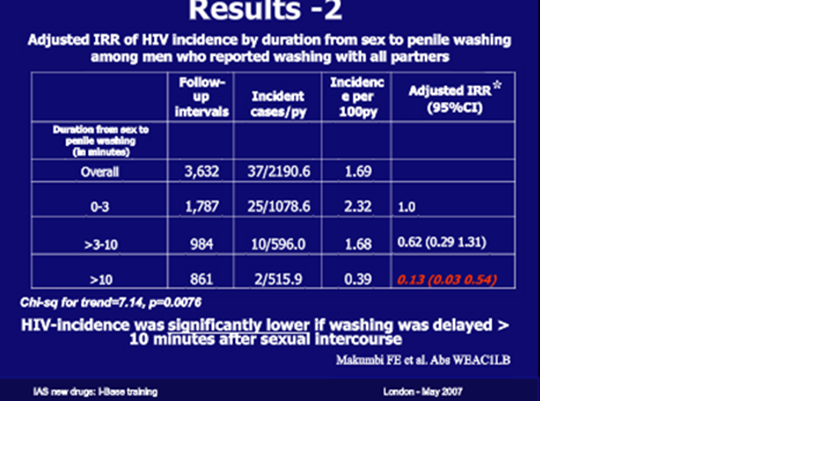
The “previous finding” referred to is an earlier report by Makumbi and colleagues in 2007, who interviewed 2552 uncircumcised men enrolled in the control arm of a randomized trial of circumcision for HIV prevention in the Rakai region of Uganda (these men are included in the data reported by Tobian and colleagues in 2009). Some of the information reported by Makumbi and colleagues is shown in the last four slides in this presentation prepared by i-Base, UK.

This is one of the slides showing that there were 2.32 HIV infections per 100PY among men who washed their penis within 3 minutes of intercourse, but only 0.39 infections per 100PY among men who waited for 10 minutes or longer before washing.

If we were to express the efficacy of delayed washing in the same way that the results of PrEP trials were reported, that is as relative risk reductions, this would mean that not washing immediately, but waiting for at least 10 minutes after intercourse before washing can reduce the risk of infection by 83%. Compare this to the 44% efficacy of Truvada in the iPrEx trial, the 39 % efficacy of tenofovir gel in reducing the risk of infection in women in the Caprisa 004 trial, and the 38-66% efficacy reported for circumcision over 24 months.

Genital washing after sex may be quite common in parts of Africa. A study in Nairobi in 2004 found that a majority of men washed their genitals after sex. Here is a link to a table in the report; 60% of men reported always washing their genitals after sex.

We have had evidence that this practice may contribute to the risk of HIV infection in men since 2007. We have to wonder if the many questions this raises have been addressed, or even considered.

Could the practice of immediate post-coital genital washing contribute to the risk of sexual transmission of HIV to men?

Are there regional variations in this practice, and could this be related to HIV prevalence to some extent?

Should there be a debate on the evidence by experts, with recommendations for further research – such as adding questions to on-going or proposed studies, laboratory testing of HIV viability in semen and vaginal fluids at body temperature or conducting a trial to nail down the risk of immediate washing, or in other words, the protective effect of delayed washing?

If immediate washing increases the risk of infection does this not raise the question of the extent to which infection occurs after withdrawal?

Considering how innocuous the intervention is do we have sufficient evidence now to advise African men at risk of HIV through heterosexual contact not to clean their penis for at least 10 minutes after sex? Should a dry cloth without water or soap be used?

The study teams for these trials have more information on post-coital penis cleaning that they have not reported. We know that for uncircumcised men, wiping was safer than washing, and waiting at least 10 minutes to clean significantly reduced risk for HIV (see the last several slides in this reference. But we don’t have similar details for circumcised men. What information has been collected but not reported?

We have evidence that a common practice, at least in certain regions can substantially increase the risk of HIV infection in men through heterosexual intercourse. Considerable attention has been given to newer prevention methods in the past few years, notably pre – exposure prophylaxis and male circumcision, but almost none to the simplest of procedures that may be even more effective in preventing the sexual transmission of HIV.

Many other questions and concerns will no doubt arise as more people look at the evidence, and figure out what to do about it. Lives are at stake. Scientific competence and integrity are also at stake – researchers have overlooked and/or incompletely reported information that could save lives.

Lessons from North American outbreaks – changing needles alone is not enough


[go to first injections page] [Note: Stephen F. Minkin (sfminkin@yahoo.com) submitted the following as a guest blog.]

The CDC [US Centers for Disease Control and Prevention] first reported on four large outbreaks of hepatitis B and hepatitis C at outpatient medical facilities between 2000 and 2002. Two outbreaks occurred in a private physician’s offices in New York, one at an Oklahoma pain remediation center, and one at a hematology/oncology clinic in Nebraska. A total of 247 patients were known to have been infected at these facilities.

In addition, unsafe practices were uncovered at a phlebotomy center in California in 2001, where needles for drawing blood were reused. As a result, 15,000 people had to be tested for HIV, hepatitis B, and hepatitis C.

Two more recent outbreaks discovered in Nevada and New York garnered considerable media attention. In November 2007, reports surfaced that a New York anesthesiologist reused syringes when withdrawing medicine from multi-dose vials. In the process he potentially exposed thousands of patients to blood-borne viruses. On December 14, 2007 the New York Department of Health contacted approximately 8,500 patients exposed by this practice and urged them to be tested for Hepatitis and HIV.

On February 29, 2008 health officials in Las Vegas closed the Endoscopy Center of Southern Nevada after six patients were diagnosed with hepatitis C.  The outbreak was traced to nurse anesthetists reusing syringes to draw up medicine from single use vials for multiple patients.

According to the CDC,

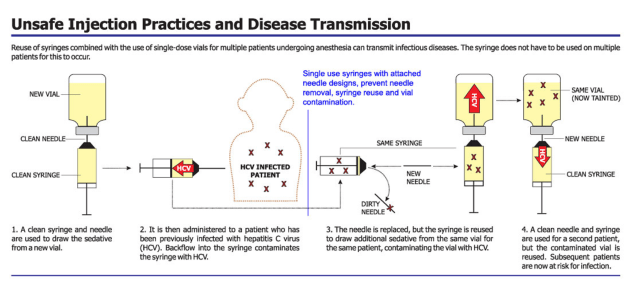
A clean needle and syringe were used to draw medication from a single-use vial of propofol, a short acting intravenous anesthetic agent.  The medicine was injected directly through an intravenous catheter into the patient’s arm.  If a patient required more sedation, the needle was removed from the syringe and replaced with a new needle; the new needle and old syringe was used to draw more medication.

This was a “common practice” at this center for at least 4 years. As a result 40,000 patients were potentially exposed to this risk of hepatitis and HIV infections.

The CDC suggests two possible ways the syringes could have been contaminated.

Backflow from the patient’s intravenous catheter or from needle removal might have contaminated the syringe with HCV (hepatitis C) and subsequently contaminated the vial. Medication remaining in the vial was used to sedate the next patient.

Investigators concluded that each of these outbreaks resulted from “unsafe injection practices primarily the reuse of syringes and needles or contamination of multiple-dose vials leading to patient to patient transmission” (page 901 in this link).

The changing of needles while reusing the syringe is very, very risky and is not a WHO recommended practice (page 35 in this link).

The 2002 Oklahoma outbreak was traced back to a nurse anesthetist supervised by an anesthesiologist at a hospital outpatient clinic. In response the American Association of Nurse Anesthetists (AANA) mailed copies of the AANA Infection Control Guidelines to its members

The organization also hired a research firm to conduct a random telephone survey of Certified Registered Nurse Anesthetists (CRNAs) and anesthesiologists “to learn more about practices and attitudes on needle and syringe reuse.”  A spokesperson termed the finding as “eye opening.”

Among the different categories of health professionals surveyed, 3 percent of anesthesiologists who responded indicated they reuse needles and/or syringes on multiple patients. CRNAs, other physicians, nurses and oral surgeons reported reuse at 1 percent or less.

Extrapolating the survey findings – 3 percent of anesthesiologists plus 1 per cent of CRNAs – equated in 2002 to approximately 1,000 anesthesia professionals who might have been exposing more than a million patients to the risks of contaminated needles and syringes.

They were forced to revisit the problem of the reuse because of the events in New York and Nevada. On March 6, 2008, Dr. Wanda Wilson, the AANA President, commented on the sad state of affairs.

It is astounding that in this day and age there are still nurse anesthetists, anesthesiologists and other health professionals who still risk using needles and syringes on more than one patient, or know of such activities and don’t report them. Published standards and guidelines dictate that single-use and disposal of these products is the best way to ensure patient safety. Patient safety is our primary focus – not cost savings, time savings, or any other factor

If the hepatitis C outbreaks in New York and Nevada demonstrated anything, it was that such incidents occur regardless of a provider’s degree, credentials, or title.  For any group to suggest otherwise is to put its collective head in the sand—it is irresponsible, negligent, and a sure invitation for yet another Nevada or New York situation to occur.

A 1990 study by Canadian researchers experimentally examined the risk of cross infection related to the multiple use of disposable syringes connected to IV tubing during anesthesia.  The authors were motivated because  “the practice of reusing disposable plastic syringes for several patients is still prevalent in North American operating rooms despite warnings about possible hazards.”

In some operating rooms, the usual practice is to reuse disposable syringes while changing needles.  This practice is based on the assumption, that since only needles enter the injection site, it is the only part that can be contaminated.  A high proportion of reused syringes were contaminated even if only the needle had contact with blood.  The probable mechanism of contamination is by aspiration into the syringe of blood remaining in the needle because of the negative pressure generated while removing the needle.

In view of these finding the authors emphasized that “changing needles alone is a useless procedure to prevent contamination.”

CDC PUBLIC HEALTH SYRINGE ADVISORY

Wait and wipe, don’t cut


[go to or return to first circumcision page]

Last week, while looking for something else, I ran across a report that has big implications for HIV/AIDS prevention in Africa: Almost five years ago, a trial of circumcision to protect men in Rakai, Uganda, reported that intact (uncircumcised) men who waited at least 10 minutes after sex before cleaning their penis were at less risk to get HIV than men who had been circumcised: intact men who waited to clean got HIV at the rate of 0.39% per year compared to 0.66% per year for circumcised men. Although the study team reported these results to an international AIDS conference in 2007, and several newspapers wrote about it at the time, the report has dropped out of view. That is a big mistake.

Why is this report important? Here are three reasons.

First, if you are intact, this report says you don’t need to get circumcised to reduce your risk to get HIV. Use a condom, of course, if your partner has or might have HIV. But if that fails, this report says you are as safe with a foreskin as you would be without one. Just don’t clean your penis for at least 10 minutes after sex, and then wipe it with a dry cloth, without water. A later report from the Uganda study team suggests waiting to clean is good for all men, both circumcised and intact: men who didn’t “wash genitals after sexual intercourse” got HIV less than 1/3rd as fast as men who did.

Second, if you are a politician or public health official who is considering whether to go along with the largely US-promoted program to circumcise 20 million African men by 2015, you can take another close look at the evidence and options. The evidence that advocates use to promote circumcision comes from three studies (in South Africa, Kenya, and Uganda during 2002-06) that recruited thousands of intact, HIV-negative men, circumcised some and not others, and then followed and retested them to see who got HIV. All three studies reported that circumcised men got less HIV. But the study team for at least one of those trials – the trial in Uganda – has data showing that intact men who waited to clean after sex got less HIV than circumcised men.

Circumcision is expensive and dangerous and takes doctors and nurses away from other tasks. Why put scarce public resources into campaigns to circumcise millions of men if you can get the same results by advising men to use condoms, and if that fails to wait least 10 minutes after sex before wiping their penis with a dry cloth?

Third, this is another example of people reporting important evidence that contradicts well-funded misinformation about HIV risks. WHO, USAID, and other organizations pay for a lot of messages – some are true and helpful, but some are at best only partial truths. It’s important for people to speak up when they have good information about how to avoid HIV risks, even though what they say disagrees with the official “line” at the time.

Here are some examples of truth meeting official misinformation.

WHO warns UN employees they might get HIV from health care in Africa, but doesn’t warn the African public. But not everyone goes along with such misinformation. For example, Demographic and Health Surveys finds and reports HIV-positive children with HIV-negative mothers (in Mozambique, Swaziland, and Uganda) and virgin men and women with HIV. As more people speak up, Africans hear that a lot of infections come from minor blood exposures, and learn how to protect themselves.

Another example of official misinformation is WHO’s continuing promotion of Depo-provera injections for birth control without warning Africans that good evidence shows – and many experts believe – using Depo-provera increases a woman’s risk for HIV. One expert who has spoken out – eloquently and repeatedly – on this issue is Paula Donovan, a former high-ranking UNICEF official, who has had the heart and courage to challenge official misinformation.

Circumcision is another issue with a lot of well-funded misinformation, but also with many people speaking out to set the record straight (eg, see the article by Daniel Ncayiyana, editor of the South African Medical Journal, in this link). Unfortunately, crucial evidence is still unreported from the three key trials of circumcision to protect men: A lot of men in the trials got HIV despite no reported sex partners – what were their risks? None of the three study teams has reported the HIV status of any of the men’s sex partners, and only two have reported minimal information about blood exposures.

As for waiting and wiping to reduce HIV risk, here’s the record of partial and incomplete information from the 2003-06 trial of circumcision to protect men in Rakai, Uganda:

13 December 2006: The US National Institutes of Health reported that men circumcised in the trial had 48% lower HIV incidence compared to intact men, WITH NO MENTION OF POST-COITAL CLEANING.

24 Feb 2007: The Uganda study team reports selected trial data in Lancet, concluding: “Male circumcision reduced HIV incidence in men… Circumcision can be recommended for HIV prevention in men.” THE ARTICLE MAKES NO MENTION OF WAITING TO CLEAN, WHICH THE TEAM’S UNDISCLOSED DATA SHOWED TO BE MORE EFFECTIVE THAN CIRCUMCISION.

28 March 2007: WHO announces recommendations from an experts’ meeting: “Based on the evidence presented…experts attending the consultation recommended that male circumcision now be recognized as an additional important intervention to reduce the risk of heterosexually acquired HIV infection in men.” SEVERAL MEMBERS FROM THE UGANDA STUDY TEAM TOOK PART IN THE MEETING. THERE IS NO INDICATION THEY TOLD ANYONE ABOUT THEIR UNDISCLOSED EVIDENCE THAT WAITING TO CLEAN WAS MORE EFFECTIVE THAN CIRCUMCISION IN PROTECTING INTACT MEN FROM HIV.

25 July 2007: Frederick Makumbi and several other members of the Uganda study team tell an international AIDS conference: Among intact men reporting post-coital cleaning with all partners, “HIV incidence was significantly higher among those reporting cleansing within 3 minutes (2.32/100 py [person-years]), compared to those reporting a delay of more than 10 minutes (0.39/100py [person-years…).” (The best source i have found for these data is the last several slides in this link.)

So there you have it: In December 2006, the Uganda study team reported that circumcised men got less HIV than intact men. Not until 8 months later, in July 2007, did they disclose evidence that intact men who waited to clean their penises got less HIV than circumcised men. Despite their 2007 report, the Uganda study team has continued to say that circumcision is the way to go, and has said nothing more about waiting to clean as an effective option to reduce HIV risk for intact men.

Africans facing HIV risks from both blood exposures and sex need good information. Well-funded official fountains of stigmatizing misinformation blame Africa’s HIV epidemics on too much sex and too many foreskins. But there are also a lot of people offering good information and evidence. As more people speak up – telling what they know about HIV risks, even if it does not coincide with the party line – the African public will get a better idea about HIV risks and how to protect themselves.