Bloodborne HIV: Don't Get Stuck!

Protect yourself from bloodborne HIV during healthcare and cosmetic services

Category Archives: blood

10 years later: Continuing unethical and incompetent behavior by medical professionals coincides with conflict of interest, leading to millions of unexplained HIV infections


Health care professionals in African ministries of health, the World Health Organization (WHO), donor organizations, and foreign universities participating in HIV-related research in Africa know the proper response to unexpected HIV infections (eg, in children with HIV-negative mothers, in spouses with one lifetime HIV-negative sex partner). That response is to find the source of the infection by tracing and testing others who attended suspected hospitals and clinics, and thereby to identify and correct unsafe practices to protect other patients. There have been no such investigations of unexpected HIV infections in any country in sub-Saharan Africa.

Health care professionals are ethically obligated to give patients accurate information about risks. The World Medical Association’s Declaration of Lisbon on the Rights of the Patient[1] states: “A mentally competent adult patient has the right to give or withhold consent to any diagnostic procedure or therapy. The patient has the right to the information necessary to make his/her decisions…” and “Every person has the right to health education that will assist him/her in making informed choices about personal health and about the available health services.”

Medical researchers trying to find what is different about HIV transmission in Africa that could explain the world’s worst HIV epidemics know that the best way to do so is to trace and test sex and blood contacts when someone shows up with a new or unexplained infection. Unfortunately, medical researchers (who are also health care professionals) have been reticent to find their colleagues’ contribution to Africa’s HIV epidemics. For example, 44 studies[2] that followed more than 120,000 adults in Africa and observed more than 4,000 new HIV infections linked only 186 (4.6%) of those infections to HIV-positive sex partners, all of which were spouses the study had been following all along. No study traced and tested any sex partner (spouse or other) not already included and followed in the study. No study traced blood contacts, and few studies reported any information about blood risks. Despite lack of evidence (avoided and ignored evidence) all studies assumed infections came from sex. (These 44 studies were randomized controlled trials of interventions to prevent HIV in African adults.)

For 30 years, medical professionals have accused HIV-positive Africans of careless or immoral sexual behavior. But if one looks for what is different in Africa vs. the US and Europe, what jumps out is not sexual misbehavior but rather unethical, immoral, and incompetent behavior by health care professionals: not investigating unexpected HIV infections; not warning the public about unsafe health care; and mismanaging research so as not to find risks for HIV.

Ten years ago, on 14 March 2003, WHO held a one-day meeting to discuss the role of unsafe medical injections in Africa’s HIV/AIDS epidemics. WHO staff arranged the meeting after a series of articles[3][4][5] in the International Journal of STD & AIDS during 2002-03 called attention to decades of overlooked evidence that unsafe health care infected Africans with HIV. The 20 invited attendees[6] included three co-authors of these articles (Brody, Gisselquist, and Potterat).

WHO staff managed the meeting as part of a continuing cover-up of hospitals’ and clinics’ contribution to Africa’s HIV epidemics. The meeting was closed to the public. A first press release, prepared by WHO staff in the days before the meeting and released before it ended, misleadingly claimed:[7] “An expert group has reaffirmed that unsafe sexual practices are responsible for the vast majority of HIV infections in sub-Saharan Africa…”

Later that year, WHO’s meeting summary[8] acknowledged that “No consensus emerged from the conference” on whether “sexual transmission was responsible for the large majority of HIV infections.” The summary also noted “universal agreement…that better data on the possible role of unsafe injections, and other health care practices, in HIV transmission are needed to more definitively determine their role in HIV transmission in sub-Saharan Africa.”

Unfortunately, the events of the last 10 years show a continuing unwillingness on the part of too many health care professionals to do what is needed to find and stop HIV transmission through unsafe health care in Africa.


[1] World Medical Association. 2005. Declaration of Lisbon on the Rights of the Patient. Ferney-Voltaire, France: WMA. Available at: http://www.wma.net/en/30publications/10policies/l4/ (accessed 18 August 2012).

[3] Gisselquist D, Rothenberg R, Potterat JJ, Drucker E. HIV infections in sub-Saharan Africa not explained by sexual or vertical transmission. By: Int J STD AIDS 2002; 13: 657-666. Available at: http://www.robertogiraldo.com/reference/Gisselquist_TransmissionIsNotSexual.pdf

[5] Gisselquist D, Potterat JJ, Brody S, Vachon F, Let it be sexual: how health care transmission of AIDS in Africa was ignored. Int J STD AIDS 2003; 14: 148-161. Available at: http://www.cirp.org/library/disease/HIV/gisselquist1/gisselquist1.pdf

[6] WHO. Unsafe injection practices and HIV Infection. Meeting summary (14 March 2003 meeting, undated summary posted by WHO later in 2003). Available at: http://www.who.int/hiv/strategic/mt14303/en/index.html (accessed 6 January 2013).

[7] WHO. Expert group stresses that unsafe sex is primary mode of transmission of HIV in Africa. Media Center statement 14 March 2003. Available at: http://www.who.int/mediacentre/news/statements/2003/statement5/en/index.html (accessed 6 January 2013).

[8] WHO. Unsafe injection practices and HIV Infection. Meeting summary (14 March 2003 meeting, undated summary posted by WHO later in 2003). Available at: http://www.who.int/hiv/strategic/mt14303/en/index.html (accessed 6 January 2013).

UNAIDS Getting to Zero: Zero Lies, Zero Double Standards and Zero Institutional Racism


According to George Ochoa “An infection spread by unsafe injection practices can happen anywhere” and finds that “Since 2001…at least 48 outbreaks caused by unsafe injection practices have occurred in the United States, with the majority (90%) in outpatient settings (10 in pain clinics and nine in oncology clinics). Twenty-one of the outbreaks involved hepatitis B or hepatitis C; 27 were bacterial. More than 150,000 patients required notification to recommend bloodborne pathogen testing following exposure to unsafe injections.”

But if UNAIDS is right, George Ochoa is wrong; HIV infections through unsafe injection hardly ever occur in high HIV prevalence countries, which are mostly in sub-Saharan Africa. That must explain why, since the HIV epidemic began 30 years ago, no outbreak investigations have been carried out in sub-Saharan Africa.

UNAIDS’ ‘Kenya Aids Epidemic Update 2011’ briefly mentions re-use of injecting equipment during immunization programs (which account for a small percentage of all injections administered). They say “In a study of young men (ages 18–24) in Kisumu, men who received a medical injection in the last six months were nearly three times more likely to be HIV-positive”.

However, the report also claims that a minuscule percentage of HIV infections were a result of any kind of unsafe healthcare and that “Sexual transmission accounts for an estimated 93% of new HIV infections in Kenya, with heterosexual intercourse representing 77% of incident infections. Adults in stable, seemingly low-risk heterosexual relationships make up the largest share of new HIV infections.”

Did they assess the non-sexual risks faced by those people in ‘seemingly low-risk’ relationships? The report says “Among adult participants in the 2003 Kenya Demographic and Health Survey who said they had “no risk” for HIV, nearly 1 in 20 (4.6%) were in reality HIV infected”. The implication is that all those people were infected sexually, but they just didn’t realize they were at risk. For the authors of the UNAIDS report, the people in question were either stupid, liars or stupid liars.

The report recognizes that if there is a large number of HIV positive people in the population, the risk for each sex act is higher. But they don’t acknowledge that the same circumstances also make the risk of infection from an unsafe injection or other skin piercing procedure far higher. HIV prevalence is about 10 times higher in Kenya than it is in the US. But there have been no reported outbreaks of HIV or any other disease as a result of unsafe healthcare in Kenya or any other sub-Saharan African country.

Another study, by WHO, says that “around half the injections used across the world are unsafe for administration, with a worse ratio in developing countries”. So is it possible that George Ochoa is right in stating that “An infection spread by unsafe injection practices can happen anywhere”, and UNAIDS wrong? Well, shocking as it may seem to those who look to UNAIDS as an institution that specializes in HIV, what they say to Africans is different from what they say to UN employees.

Here’s what they have to say to UN employees: “Use of improperly sterilized syringes and other medical equipment in health-care settings can also result in HIV transmission. We in the UN system are unlikely to become infected this way since the UN-system medical services take all the necessary precautions and use only new or sterilized equipment. Extra precautions should be taken, however, when on travel away from UN approved medical facilities, as the UN cannot ensure the safety of blood supplies or injection equipment obtained elsewhere. It is always a good idea to avoid direct exposure to another person’s blood — to avoid not only HIV but also hepatitis and other bloodborne infections.

They also say: “In several regions, unsafe blood collection and transfusion practices and the use of contaminated syringes account for a notable share of new infections. Because we are UN employees, we and our families are able to receive medical services in safe healthcare settings, where only sterile syringes and medical equipment are used, eliminating any risk to you of HIV transmission as a result of health care.

I don’t know about anyone else, but I tend to believe the warning they give to UN employees, but that suggests they are lying about the risk that Africans face from unsafe healthcare. Why would this august institution lie about a very serious risk of HIV infection in the highest HIV prevalence countries in the world? Well, I can’t answer that question. If it’s vital to warn UN employees, it should be vital to warn those who don’t actually have much choice about which health facilities to use, UN approved or otherwise.

UNAIDS’ current touchy-feely campaign is called ‘Getting to Zero: zero new infections, zero discrimination, zero Aids related deaths’. How about ‘zero lies, zero double standards and zero institutional racism’ as an alternative set of objectives?

WHO Acknowledges HIV Risk in Ugandan Hospitals?


I know infection control professionals are not common in African countries but I hadn’t realized that up till recently there were none at all in Uganda. I wonder how many there are in countries that have received only a fraction of the funding Uganda has received, especially HIV funding. A WHO article about their ‘African Partnerships for Patient Safety’ initiative announces that one hospital, seven hours drive from the capital city, now “has its own infection control professional, the first in the country”. The article proudly states that “just two years ago, patient safety was an obscure concept that was almost impossible for hospital staff to apply when faced with practical realities”.

Could this be the same WHO that tells us that the vast majority of HIV infections in Uganda are a result of unsafe sex? True, the fact that patient safety was an ‘obscure concept’ does not mean that HIV transmission through unsafe healthcare is common. Rather, it means that we, WHO included, have no idea whether such transmission is common or not. We don’t know what proportion of HIV transmission is a result of unsafe healthcare and, therefore, what proportion is a result of the WHO’s beloved sexual transmission. Not that this stops WHO, UNAIDS and others from droning on about African sexual practices, ‘dry sex’, concurrency, circumcision, widow inheritance, long distance truckers, commercial sex workers and the rest, as if that’s all there is to HIV epidemics where many of the people infected face little or no obvious sexual risk.

The most striking thing about the official Modes of Transmission Survey for Uganda is that the largest group contributing to new infections consists of people in stable heterosexual couples. In many of those couples the index partner, the one infected first, is female (fewer males are infected but there is equally little evidence that they were all infected through unsafe sex). As the first to be infected, these women could not have been infected by their partners. So how were they infected? According to UNAIDS and WHO thinking, they must have had sex with someone other than their partner. The UN’s IRIN news service refers to them as ‘cheaters’, which is a reflection of IRIN’s typical style and level of sensitivity. But can the Modes of Transmission Survey rule out non-sexual transmission of HIV through unsafe healthcare, traditional and cosmetic practices in this group of people who face such low sexual risk? The simple answer is ‘no’. For UNAIDS, WHO and other institutions, it is simply taken for granted that the bulk of transmission is through unsafe sex. Questions about non-sexual risks are rarely raised and peremptorily dismissed if mentioned.

Survey after survey shows that those who engage in unsafe sex are no more likely to be infected that those who don’t; often, those who don’t engage in unsafe sex are more likely to be infected. High HIV prevalence does not tend to cluster in isolated areas, except where there have been major health programs. It does tend to cluster among wealthier, better educated, more mobile, employed people who are close to major transport routes and close to or in major cities; coincidentally, they also tend to be much closer to health facilities. Is one infection control expert in an isolated hospital in Uganda going to make much difference to transmission rates? Possibly in that hospital. But it is the initial assumption made by WHO, UNAIDS, etc, that needs to change: knowing someone’s HIV status tells you nothing about their sexual behavior and knowing about their sexual behavior is not a good predictor of their HIV status.

That may sound counter-intuitive if your ‘intuition’ is based on reading mainstream press, and even much of the more specialized scientific literature. HIV in African countries is almost invariably associated with sexual behavior. In Western countries this is not the case. HIV in wealthier countries tends to be attributed to intravenous drug use and male to male sex. Even in Asian countries, people are sometimes given a little benefit of doubt; they may have been infected through unsafe healthcare. But in African countries with the worst epidemics, there has never been an investigation into healthcare practices; there has never been an investigation into why so many women in Uganda (for example) are infected when their husbands are not, and where these women did not face any other obvious risks; there has never been an investigation into why so many babies are infected when their mothers are not; in fact, what proportion of babies are infected whose mothers are not? We don’t know the answer to these questions we appear not to even want to ask.

Does the ‘African Partnerships for Patient Safety‘ indicate an admission that patient safety could be a factor in some of the world’s worst HIV epidemics, after thirty years of insisting that HIV is all about sex and wasting billions of dollars accordingly, or is it mere lip service? I won’t be holding my breath.

Maternal Health Care a Significant HIV Risk in Ethiopia


[Cross-posted from the HIV in Kenya blog.]

A young doctor who had been working for 26-28 hours was taking blood from a baby born to a HIV positive mother and accidentally pricked himself with the needle. He reported the incident and got some kind of treatment in the same hospital, but he had to drive himself to another hospital 45 minutes away to get the drugs he needed after being awake for 29 hours. There are several issues here but I’d like to concentrate on the fact that a hospital that had a HIV positive female patient did not have the drugs required to administer post-exposure prophylaxis. Thankfully the doctor in question was OK, but he had to wait six months to have that confirmed.

An accident like this could occur in any country in the world. In this instance it happened in Ireland, where HIV prevalence is very low, around 0.2%. The mother was known to be HIV positive, whereas the HIV status of a significant proportion of people in many countries, perhaps the majority of people in high prevalence countries, would not be known. Needlestick injuries are more common in places where there are fewer staff, less well trained staff and where access to supplies and equipment are poor. But even in countries where conditions for infection control are probably good there can be slips, such as the one described above.

Of course, the fact that conditions for infection control are not good in developing countries does not mean HIV is frequently transmitted through unsafe medical procedures. UNAIDS, WHO and the rest may be right in their claim that only 2-2.5% of HIV transmission is accounted for by unsafe injections, contaminated blood transfusions and other health care risks. But it would be comforting to hear that unexplained HIV outbreaks are investigated. It’s not as if there are no such unexplained outbreaks; many infants are found to be HIV positive even though their mother is negative; many adults are infected even though they have no identifiable sexual risk, etc.

One of the oldest high prevalence HIV epidemics in Africa, that in Uganda, should have taught us a lot. It is now obvious that at least some of the rapid drop in prevalence after its peak in the late 80s must have been a result of high death rates. Some of the drop in incidence, the rate of new infections, must have been a result of improvements in infection control practices in health facilities. Very little of the drop in infections can clearly be associated with various ‘initiatives’ aiming to address sexual behavior, which (much) later became known as ABC (Abstain, Be faithful and use Condoms). So why is there now so much emphasis on sexual behavior when we know that many of those approaches have had very little impact, in Uganda or anywhere else?

According to an article from IRIN news, Uganda is targeting ‘cheaters’. This is an extremely inept piece of campaigning (and reporting). Knowing that someone is HIV positive is not the same as knowing how they became infected. The data itself even suggests that most of the people considered to be ‘cheaters’ could not have been infected through sexual behavior because their behavior is classified as low risk. Some of them may have been infected sexually, but it is unlikely that they all were. Yet this group, people who are in long-term relationships, often married, makes up the biggest group of HIV positive people, 43% of all new infections. To establish how they became infected it is first necessary to do some investigating.

Another group of unexplained infections can be found among women of child-bearing age. Some may well be infected sexually, but some may not. It’s certainly not a foregone conclusion that all of them must have been infected sexually just because they have had sex. The group that is especially in need of investigation is those who have given birth with the assistance of a health care professional. The 2005 Demographic and Health Survey for Ethiopia shows that HIV prevalence is eight times higher for this group (prevalence is 9.9% for those who received assistance from a health professional and 1.2% for those who gave birth without assistance from a health professional). In addition, HIV prevalence is a lot lower among men. HIV in Ethiopia is very low in rural areas and appears to be higher among employed, better educated, wealthier people who live in urban areas. A more recent Demographic and Health Survey for Ethiopia was published in 2011, but there is no figure cited for this group.

There are so many ways HIV can be transmitted, especially in countries where HIV prevalence is high and most people don’t know they are infected. It must also be remembered that most people don’t realize that there are significant non-sexual risks; if they don’t know about the risks they will not know anything about protecting themselves and their families. There are health care risks, such as operations, vaccinations and dental care, traditional practices, such as circumcision, scarification and traditional medicine and cosmetic risks, such as manicures, pedicures, tattoos and piercing.

Rather than continuing to waste money on sexual behavior interventions, many of which have been largely unsuccessful and all of which fuel the stigma that attaches to HIV infection in African countries, it is time to investigate non-sexual transmission in all its forms. If there is any shortage of evidence that non-sexual HIV transmission makes a significant and underestimated contribution to serious HIV epidemics, that can only be because of a lack of research and a lack of investigation where levels of HIV transmission are unexplained by sexual behavior alone.

Donor countries, including Ireland, are keen to get women in developing countries to use ante-natal care clinics and other health facilities. Far more important than providing people with health care is providing people with safe health care; otherwise we could be increasing risk of transmission of HIV and other infectious diseases rather than reducing risk. Needlestick incidents are probably the least of people’s worries in countries like Ethiopia, but only because many people don’t attend health facilities most of the time. If our aim is to increase access to health care we had better ensure that health facilities are also safe.

[For more about non-sexual HIV transmission and mass male circumcision, see the Don’t Get Stuck With HIV site.]

Circumcision: a Case of Retributive Healthcare?


[Cross-posted from the HIV in Kenya site.]

There are many objections to mass male circumcision, but only a few of them should be required to convince someone that the vast majority of operations should never have been carried out, and that infant circumcision should not be routine anywhere. I would attach most weight to the argument that infant circumcision is a denial of the right to bodily integrity and follow that up with the consideration that it is done without consent, and can easily be postponed until the infant grows up. Where consent can truly be claimed to be informed, adult circumcision should not be so problematic. Current mass male circumcision programs in African countries are demonstrating clearly that most adult men do not choose to be circumcised; whether those who have consented are appropriately informed is open to question.

But the most important objection against mass male circumcision as a HIV transmission reduction intervention is, in my view, that not all HIV transmission is a result of sexual intercourse. Circumcision does not reduce non-sexual HIV transmission, for example, that which is a result of unsafe healthcare, cosmetic or traditional practices. The majority of circumcisions in Africa are carried out in traditional, non-sterile conditions. But even conditions in hospitals and clinics are well known to be unsafe. The UN are very clear on this point, issuing its employees with their own injecting equipment when they are in developing countries because “there is no guarantee of the proper sterilization of such materials.” UN employees are also reassured that “We in the UN system are unlikely to become infected this way since the UN-system medical services take all the necessary precautions and use only new or sterilized equipment.”

The US Centers for Disease Control (CDC) states that “Injection safety is part of the minimum expectation for safe care anywhere healthcare is delivered; yet, CDC has had to investigate outbreak after outbreak of life-threatening infections caused by injection errors.  How can this completely preventable problem continue to go unchecked?  Lack of initial and continued infection control training, denial of the problem, reimbursement pressures, drug shortages, and lack of appreciation for the consequences have all been used as excuses; but in 2012 there is no acceptable excuse for an unsafe injection in the United States.

But what about safe healthcare in developing countries? The Safepoint Trust finds that each and every year due to unsafe injections there are:

  • 230,000 HIV Infections
  • 1,000,000 Hepatitis C Infections
  • 21,000,000 Hepatitis B Infections
  • The above resulting in 1,300,000 deaths each year (WHO figures)
  • Syringe re-use kills more people than Malaria a year which the WHO estimate kills 1,000,000 a year (WHO)
  • At least 50% of injections given were unsafe (WHO)

Safepoint only reports on injections. What about other healthcare procedures that may spread diseases, especially deadly ones? Many health facilities lack basic infection control capabilities and supplies, such as clean water, soap, gloves, disinfectant and much else. There are also the risks people face as a result of cosmetic procedures, such as pedicures and tattoos, and traditional procedures, such as scarification, male and female genital mutilation and traditional medicine.

Why are we even talking about something as invasive as circumcision, involving tens of millions of men and possibly hundreds of millions of infants? So many medical procedures are already carried out in unsterile conditions and can expose patients to risks of infection with HIV, hepatitis and perhaps other diseases. The circumcision operation itself is a risk for HIV and unless the risk of hospital transmitted HIV infection is acknowledged, it is not acceptable to carry out these mass male circumcision programs. It is not possible to claim that people can give their informed consent where they are unaware of the risk of infection through non-sexual routes.

A third important objection to mass male circumcision is that people in developing countries, particularly the high HIV prevalence African countries where all these mass male circumcision programs are taking place, are denied many of the most basic types of treatment. How can we propose universal infant circumcision where half of all infant deaths and a massive percentage of serious infant sickness is a result of systematic denial of basic human rights, such as access to clean water and sanitation, adequate levels of nutrition, decent living conditions, basic health services, an acceptable level of literacy and education, employment, infrastructure and a lot more?

To force ‘healthcare’ in the form of mass male circumcision programs on people who are lacking so many more important things is extremely patronizing, at best. But to force unsafe healthcare on people who have little access to the kind of information they need to be sure that they are protecting themselves against infection with HIV and other diseases, and against all the threats of unsafe healthcare, would be criminal behavior in western countries. Why are western countries silent about this treatment of people in developing countries? Are we punishing Africans for their poverty and lack of development, or just for their perceived sexual behavior? Mass male circumcision programs do seem very much like a form of ‘retributive healthcare’.

Outbreak investigations: Facing and fixing problems


If a hospital or clinic infects you or your child with HIV, you’d probably call it a disaster. Health care bureaucrats and managers call it an “adverse event.”  How often do patients get HIV from health care in Africa? The World Health Organization (WHO) has estimated it happens 50,000-100,000 times each year.  Other estimates are higher.

That’s a lot of “adverse events.” In more than 25 years, no international agency, no donor health aid program, and no African government has done the right thing to stop them.

When a department of health finds one or several unexplained HIV infections in patients that can be traced to a suspected hospital or clinic, the recommended “textbook” response is to investigate — to invite others who attended the same facility to come for tests to see how many, if any, others are infected. By finding others infected in the same outbreak, an investigation can pin-point the errors that did the damage. This alerts health care workers to fix things they didn’t know were problems, and warns patients to demand safe care. In this way, investigations save lives.

Consider the response to “adverse events” in other countries. For example, although the US health care system is not the best or safest in the world by a long shot, US state and federal governments have been doing the right thing in response to unexplained infections of hepatitis B and C virus. In health care settings, these viruses transmit just like HIV – from patient-to-patient through blood-to-blood contact when doctors and nurses reuse instruments without sterilization.

In 10 years from 1998 through 2008, the US Centers for Disease Control (CDC) recorded 33 investigations of hepatitis B and/or C transmission through health care in clinics, nursing homes, etc. Each investigation tested from 4 to >12,000 patients. The 33 investigations found a total of 448 hepatitis B and C infections from health care (average of 13 infections per outbreak). During the next 3 years, 2008-11, 32 investigations (including 3 from the previous list plus 29 new ones) invited a total of more than 90,000 patients to come for tests and identified a total of 217 infections (average of 7 per outbreak).

Did these investigations scare people to stay away from health care? Maybe some people got scared. But the real impact goes the other way: The fact that government is alert to investigate unexplained infections assures the public that someone is watching.

Consider the alternative – what happens when there are no investigations? Not investigating unexplained infections is like smelling smoke, ignoring it, and letting the house burn down. Or yelling at your dog to be quiet when she barks at night – and waking up to find your motorcycle missing.

Aside from a few HIV infections traced to blood transfusions, there have been no investigations of any of the thousands of recognized HIV “adverse events” in Africa. During 1991-93, for example, a WHO study in Rwanda, Tanzania, Uganda, and Zambia identified 61 children aged 6-60 months who were HIV-positive with HIV-negative mothers. There is no report of any investigation in any of the four countries to find the source of these unexplained infections. Incredibly, the WHO study team concluded “The risk of nosocomial [hospital-acquired]…HIV infection appears low among these populations.”

Ideally, foreign experts and agencies would be at the forefront to help with investigations. That has not happened.

Lack of interest on the part of international agencies and donors leaves African governments with the task. Which government will take the lead to begin to investigate unexplained HIV infections? Investigations are not expensive in monetary terms – but they may ruffle feathers. Someone has to push — to persuade health care bureaucrats to recognize and investigate HIV “adverse events.”

Have we ignored a very simple procedure that could significantly reduce the risk of sexual transmission of HIV to men from women?


This was written together with Joseph Sonnabend [go to or return to first circumcision page]

In 2010 there was a great deal of outraged comment about the US government’s award of $823,000 to an HIV related project in Africa. Specifically, the taxpayer dollars were to be used to teach uncircumcised African men how to wash their genitals after having sex. The grant states; “If we find that men are able to practice consistent washing practices after sex, we will plan to test whether this might protect men from becoming HIV infected in a later study.”

The reasoning behind the project was based on the assumption that the reported protective effect of male circumcision was due to improved genital hygiene. This is in the project description:

“The protective effect of male circumcision on HIV acquisition may be due to improved genital hygiene. We propose to evaluate the feasibility of a post-coital genital hygiene study among men unwilling to be circumcised in Orange Farm, South Africa. Men in high prevalence settings could potentially benefit from improved genital hygiene if this intervention proved to be efficacious in reducing HIV acquisition risk” Genital hygiene was to be improved by asking men to wash their penis after sex.

Widespread criticism of such a use of public funds might have missed the main problem. As it turns out, not washing immediately after sex may actually have a significant protective effective for men at risk from heterosexual intercourse – including both circumcised and uncircumcised men

This was noted in two randomized studies of male circumcision to prevent HIV infection in the Rakai region of Uganda in 2003-2007. Although the effect of washing on HIV acquisition received some media attention at the time its relevance to HIV prevention remained generally unnoticed. It apparently also remained unnoticed or considered to be of no consequence to the applicants as well as the funders of the $823,000 grant noted above.

Combining results from these two trials, Tobian and colleagues in an article in AIDS in 2009 report information on risks for 105 HIV seroconversions in 6,396 initially HIV-negative men observed during 9,604 person years (PY) of follow-up. Half the men were circumcised for the trial and half remained uncircumcised.

These 105 HIV seroconversions represent 1.09 infections per 100 PY.

Among the questions that trial participants were asked in attempting to define risks for HIV infection was whether or not they washed their genitals after sex.

Among men who did so there were 1.35 infections per 100PY compared to only 0.38 infections per 100PY among men who did not wash their genitals. The adjusted relative risk for washing vs. not washing was 3.04 (95% confidence interval: 1.11-8.33; P = 0.031).

The authors make the following comment in their discussion,

“The finding that HIV incidence was increased with washing genitals after sexual intercourse is counterintuitive, but supports previous finding that washing the penis within 10 min of sexual intercourse increases the risk of HIV acquisition among uncircumcised men. The increased HIV acquisition with penile washing may be due to the removal of acidic vaginal secretions or the addition of water with a neutral pH may assist HIV survival and infectivity”.

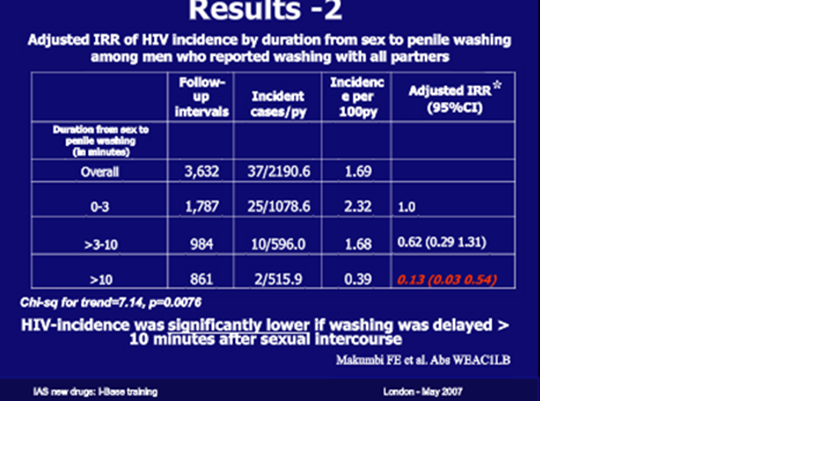
The “previous finding” referred to is an earlier report by Makumbi and colleagues in 2007, who interviewed 2552 uncircumcised men enrolled in the control arm of a randomized trial of circumcision for HIV prevention in the Rakai region of Uganda (these men are included in the data reported by Tobian and colleagues in 2009). Some of the information reported by Makumbi and colleagues is shown in the last four slides in this presentation prepared by i-Base, UK.

This is one of the slides showing that there were 2.32 HIV infections per 100PY among men who washed their penis within 3 minutes of intercourse, but only 0.39 infections per 100PY among men who waited for 10 minutes or longer before washing.

If we were to express the efficacy of delayed washing in the same way that the results of PrEP trials were reported, that is as relative risk reductions, this would mean that not washing immediately, but waiting for at least 10 minutes after intercourse before washing can reduce the risk of infection by 83%. Compare this to the 44% efficacy of Truvada in the iPrEx trial, the 39 % efficacy of tenofovir gel in reducing the risk of infection in women in the Caprisa 004 trial, and the 38-66% efficacy reported for circumcision over 24 months.

Genital washing after sex may be quite common in parts of Africa. A study in Nairobi in 2004 found that a majority of men washed their genitals after sex. Here is a link to a table in the report; 60% of men reported always washing their genitals after sex.

We have had evidence that this practice may contribute to the risk of HIV infection in men since 2007. We have to wonder if the many questions this raises have been addressed, or even considered.

Could the practice of immediate post-coital genital washing contribute to the risk of sexual transmission of HIV to men?

Are there regional variations in this practice, and could this be related to HIV prevalence to some extent?

Should there be a debate on the evidence by experts, with recommendations for further research – such as adding questions to on-going or proposed studies, laboratory testing of HIV viability in semen and vaginal fluids at body temperature or conducting a trial to nail down the risk of immediate washing, or in other words, the protective effect of delayed washing?

If immediate washing increases the risk of infection does this not raise the question of the extent to which infection occurs after withdrawal?

Considering how innocuous the intervention is do we have sufficient evidence now to advise African men at risk of HIV through heterosexual contact not to clean their penis for at least 10 minutes after sex? Should a dry cloth without water or soap be used?

The study teams for these trials have more information on post-coital penis cleaning that they have not reported. We know that for uncircumcised men, wiping was safer than washing, and waiting at least 10 minutes to clean significantly reduced risk for HIV (see the last several slides in this reference. But we don’t have similar details for circumcised men. What information has been collected but not reported?

We have evidence that a common practice, at least in certain regions can substantially increase the risk of HIV infection in men through heterosexual intercourse. Considerable attention has been given to newer prevention methods in the past few years, notably pre – exposure prophylaxis and male circumcision, but almost none to the simplest of procedures that may be even more effective in preventing the sexual transmission of HIV.

Many other questions and concerns will no doubt arise as more people look at the evidence, and figure out what to do about it. Lives are at stake. Scientific competence and integrity are also at stake – researchers have overlooked and/or incompletely reported information that could save lives.

Lessons from North American outbreaks – changing needles alone is not enough


[go to first injections page] [Note: Stephen F. Minkin (sfminkin@yahoo.com) submitted the following as a guest blog.]

The CDC [US Centers for Disease Control and Prevention] first reported on four large outbreaks of hepatitis B and hepatitis C at outpatient medical facilities between 2000 and 2002. Two outbreaks occurred in a private physician’s offices in New York, one at an Oklahoma pain remediation center, and one at a hematology/oncology clinic in Nebraska. A total of 247 patients were known to have been infected at these facilities.

In addition, unsafe practices were uncovered at a phlebotomy center in California in 2001, where needles for drawing blood were reused. As a result, 15,000 people had to be tested for HIV, hepatitis B, and hepatitis C.

Two more recent outbreaks discovered in Nevada and New York garnered considerable media attention. In November 2007, reports surfaced that a New York anesthesiologist reused syringes when withdrawing medicine from multi-dose vials. In the process he potentially exposed thousands of patients to blood-borne viruses. On December 14, 2007 the New York Department of Health contacted approximately 8,500 patients exposed by this practice and urged them to be tested for Hepatitis and HIV.

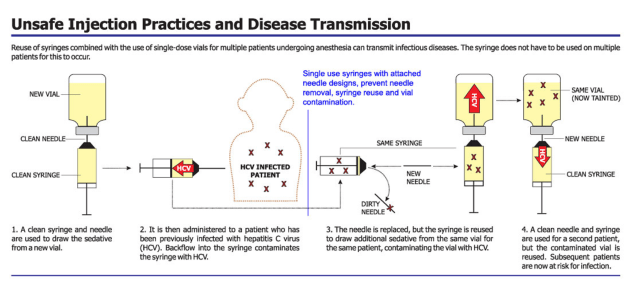
On February 29, 2008 health officials in Las Vegas closed the Endoscopy Center of Southern Nevada after six patients were diagnosed with hepatitis C.  The outbreak was traced to nurse anesthetists reusing syringes to draw up medicine from single use vials for multiple patients.

According to the CDC,

A clean needle and syringe were used to draw medication from a single-use vial of propofol, a short acting intravenous anesthetic agent.  The medicine was injected directly through an intravenous catheter into the patient’s arm.  If a patient required more sedation, the needle was removed from the syringe and replaced with a new needle; the new needle and old syringe was used to draw more medication.

This was a “common practice” at this center for at least 4 years. As a result 40,000 patients were potentially exposed to this risk of hepatitis and HIV infections.

The CDC suggests two possible ways the syringes could have been contaminated.

Backflow from the patient’s intravenous catheter or from needle removal might have contaminated the syringe with HCV (hepatitis C) and subsequently contaminated the vial. Medication remaining in the vial was used to sedate the next patient.

Investigators concluded that each of these outbreaks resulted from “unsafe injection practices primarily the reuse of syringes and needles or contamination of multiple-dose vials leading to patient to patient transmission” (page 901 in this link).

The changing of needles while reusing the syringe is very, very risky and is not a WHO recommended practice (page 35 in this link).

The 2002 Oklahoma outbreak was traced back to a nurse anesthetist supervised by an anesthesiologist at a hospital outpatient clinic. In response the American Association of Nurse Anesthetists (AANA) mailed copies of the AANA Infection Control Guidelines to its members

The organization also hired a research firm to conduct a random telephone survey of Certified Registered Nurse Anesthetists (CRNAs) and anesthesiologists “to learn more about practices and attitudes on needle and syringe reuse.”  A spokesperson termed the finding as “eye opening.”

Among the different categories of health professionals surveyed, 3 percent of anesthesiologists who responded indicated they reuse needles and/or syringes on multiple patients. CRNAs, other physicians, nurses and oral surgeons reported reuse at 1 percent or less.

Extrapolating the survey findings – 3 percent of anesthesiologists plus 1 per cent of CRNAs – equated in 2002 to approximately 1,000 anesthesia professionals who might have been exposing more than a million patients to the risks of contaminated needles and syringes.

They were forced to revisit the problem of the reuse because of the events in New York and Nevada. On March 6, 2008, Dr. Wanda Wilson, the AANA President, commented on the sad state of affairs.

It is astounding that in this day and age there are still nurse anesthetists, anesthesiologists and other health professionals who still risk using needles and syringes on more than one patient, or know of such activities and don’t report them. Published standards and guidelines dictate that single-use and disposal of these products is the best way to ensure patient safety. Patient safety is our primary focus – not cost savings, time savings, or any other factor

If the hepatitis C outbreaks in New York and Nevada demonstrated anything, it was that such incidents occur regardless of a provider’s degree, credentials, or title.  For any group to suggest otherwise is to put its collective head in the sand—it is irresponsible, negligent, and a sure invitation for yet another Nevada or New York situation to occur.

A 1990 study by Canadian researchers experimentally examined the risk of cross infection related to the multiple use of disposable syringes connected to IV tubing during anesthesia.  The authors were motivated because  “the practice of reusing disposable plastic syringes for several patients is still prevalent in North American operating rooms despite warnings about possible hazards.”

In some operating rooms, the usual practice is to reuse disposable syringes while changing needles.  This practice is based on the assumption, that since only needles enter the injection site, it is the only part that can be contaminated.  A high proportion of reused syringes were contaminated even if only the needle had contact with blood.  The probable mechanism of contamination is by aspiration into the syringe of blood remaining in the needle because of the negative pressure generated while removing the needle.

In view of these finding the authors emphasized that “changing needles alone is a useless procedure to prevent contamination.”

CDC PUBLIC HEALTH SYRINGE ADVISORY

Wait and wipe, don’t cut


[go to or return to first circumcision page]

Last week, while looking for something else, I ran across a report that has big implications for HIV/AIDS prevention in Africa: Almost five years ago, a trial of circumcision to protect men in Rakai, Uganda, reported that intact (uncircumcised) men who waited at least 10 minutes after sex before cleaning their penis were at less risk to get HIV than men who had been circumcised: intact men who waited to clean got HIV at the rate of 0.39% per year compared to 0.66% per year for circumcised men. Although the study team reported these results to an international AIDS conference in 2007, and several newspapers wrote about it at the time, the report has dropped out of view. That is a big mistake.

Why is this report important? Here are three reasons.

First, if you are intact, this report says you don’t need to get circumcised to reduce your risk to get HIV. Use a condom, of course, if your partner has or might have HIV. But if that fails, this report says you are as safe with a foreskin as you would be without one. Just don’t clean your penis for at least 10 minutes after sex, and then wipe it with a dry cloth, without water. A later report from the Uganda study team suggests waiting to clean is good for all men, both circumcised and intact: men who didn’t “wash genitals after sexual intercourse” got HIV less than 1/3rd as fast as men who did.

Second, if you are a politician or public health official who is considering whether to go along with the largely US-promoted program to circumcise 20 million African men by 2015, you can take another close look at the evidence and options. The evidence that advocates use to promote circumcision comes from three studies (in South Africa, Kenya, and Uganda during 2002-06) that recruited thousands of intact, HIV-negative men, circumcised some and not others, and then followed and retested them to see who got HIV. All three studies reported that circumcised men got less HIV. But the study team for at least one of those trials – the trial in Uganda – has data showing that intact men who waited to clean after sex got less HIV than circumcised men.

Circumcision is expensive and dangerous and takes doctors and nurses away from other tasks. Why put scarce public resources into campaigns to circumcise millions of men if you can get the same results by advising men to use condoms, and if that fails to wait least 10 minutes after sex before wiping their penis with a dry cloth?

Third, this is another example of people reporting important evidence that contradicts well-funded misinformation about HIV risks. WHO, USAID, and other organizations pay for a lot of messages – some are true and helpful, but some are at best only partial truths. It’s important for people to speak up when they have good information about how to avoid HIV risks, even though what they say disagrees with the official “line” at the time.

Here are some examples of truth meeting official misinformation.

WHO warns UN employees they might get HIV from health care in Africa, but doesn’t warn the African public. But not everyone goes along with such misinformation. For example, Demographic and Health Surveys finds and reports HIV-positive children with HIV-negative mothers (in Mozambique, Swaziland, and Uganda) and virgin men and women with HIV. As more people speak up, Africans hear that a lot of infections come from minor blood exposures, and learn how to protect themselves.

Another example of official misinformation is WHO’s continuing promotion of Depo-provera injections for birth control without warning Africans that good evidence shows – and many experts believe – using Depo-provera increases a woman’s risk for HIV. One expert who has spoken out – eloquently and repeatedly – on this issue is Paula Donovan, a former high-ranking UNICEF official, who has had the heart and courage to challenge official misinformation.

Circumcision is another issue with a lot of well-funded misinformation, but also with many people speaking out to set the record straight (eg, see the article by Daniel Ncayiyana, editor of the South African Medical Journal, in this link). Unfortunately, crucial evidence is still unreported from the three key trials of circumcision to protect men: A lot of men in the trials got HIV despite no reported sex partners – what were their risks? None of the three study teams has reported the HIV status of any of the men’s sex partners, and only two have reported minimal information about blood exposures.

As for waiting and wiping to reduce HIV risk, here’s the record of partial and incomplete information from the 2003-06 trial of circumcision to protect men in Rakai, Uganda:

13 December 2006: The US National Institutes of Health reported that men circumcised in the trial had 48% lower HIV incidence compared to intact men, WITH NO MENTION OF POST-COITAL CLEANING.

24 Feb 2007: The Uganda study team reports selected trial data in Lancet, concluding: “Male circumcision reduced HIV incidence in men… Circumcision can be recommended for HIV prevention in men.” THE ARTICLE MAKES NO MENTION OF WAITING TO CLEAN, WHICH THE TEAM’S UNDISCLOSED DATA SHOWED TO BE MORE EFFECTIVE THAN CIRCUMCISION.

28 March 2007: WHO announces recommendations from an experts’ meeting: “Based on the evidence presented…experts attending the consultation recommended that male circumcision now be recognized as an additional important intervention to reduce the risk of heterosexually acquired HIV infection in men.” SEVERAL MEMBERS FROM THE UGANDA STUDY TEAM TOOK PART IN THE MEETING. THERE IS NO INDICATION THEY TOLD ANYONE ABOUT THEIR UNDISCLOSED EVIDENCE THAT WAITING TO CLEAN WAS MORE EFFECTIVE THAN CIRCUMCISION IN PROTECTING INTACT MEN FROM HIV.

25 July 2007: Frederick Makumbi and several other members of the Uganda study team tell an international AIDS conference: Among intact men reporting post-coital cleaning with all partners, “HIV incidence was significantly higher among those reporting cleansing within 3 minutes (2.32/100 py [person-years]), compared to those reporting a delay of more than 10 minutes (0.39/100py [person-years…).” (The best source i have found for these data is the last several slides in this link.)

So there you have it: In December 2006, the Uganda study team reported that circumcised men got less HIV than intact men. Not until 8 months later, in July 2007, did they disclose evidence that intact men who waited to clean their penises got less HIV than circumcised men. Despite their 2007 report, the Uganda study team has continued to say that circumcision is the way to go, and has said nothing more about waiting to clean as an effective option to reduce HIV risk for intact men.

Africans facing HIV risks from both blood exposures and sex need good information. Well-funded official fountains of stigmatizing misinformation blame Africa’s HIV epidemics on too much sex and too many foreskins. But there are also a lot of people offering good information and evidence. As more people speak up – telling what they know about HIV risks, even if it does not coincide with the party line – the African public will get a better idea about HIV risks and how to protect themselves.

SAVE families, stop HIV!


The International (formerly African) Network of Religious Leaders living with or Affected by HIV/AIDS (INERELA+) promotes SAVE as a response to Africa’s HIV/AIDS epidemic. SAVE stands for: Safe sexual and skin-piercing behavior; Access to treatment; Voluntary counseling and testing; and Empowerment. This note considers some of the ways that SAVE could strengthen HIV prevention in Africa.

AIDS was first recognized in Africa in 1982. In 2010, 28 years later, the World Health Organization (WHO) estimated that 22.9 million Africans were living with HIV, including 1.9 million with new infections in that year. These infections are not distributed evenly. The people most at risk live in cities in 15 countries, primarily in Southern and Eastern Africa. In these cities, from 20% to more than 50% of men and women aged 15 years today can expect to get HIV at some time during their lives.

Help husbands and wives stop intra-familial HIV transmission

Unlike Western countries, where almost all HIV transmission occurs outside families, a lot of HIV transmission in Africa happens within families – mother-to-child and spouse-to-spouse transmission together account for an estimated 45% of new infections.

(a) Mother-to-child transmission: According to WHO estimates, 390,000 babies in Africa got HIV from HIV-positive mothers in 2010, accounting for an estimated 20% of 1.9 million new HIV infections in Africa in that year (390,000/1,900,000 = 20.5%, rounded to 20%).

(b) Spouse-to-spouse transmission: An estimated 30% of all HIV-positive adults in Africa are married to HIV-negative partners, and the resultant spouse-to-spouse transmission accounts for approximately 470,000 HIV infections per year, equivalent to 25% of all new infections each year (470,000/1,900,000 = 25%). (A note at the end of this blog shows the source of these data and explains this estimate.)

Most Western experts continue to identify high risk groups in Africa, as in the US and Europe, according to extramarital sex – prostitutes, clients, truck drivers, and youth are considered to be at high risk because they have more than average levels of extramarital sex. But in Africa, none of these groups defined by extramarital sex has risks as high as babies born to HIV-positive mothers (without treatment, 35% are infected in 2 years) or spouses not aware their partners are HIV-positive partners (8% per year). In other words, the term “high risk groups” in Africa applies first and foremost to persons with intra-familial risks.

With good information and with some medical assistance husbands and wives can work together to stop 700,000 infections per year – reducing mother-to-child transmission by 320,000 (from 390,000 to 70,000) and spouse-to-spouse transmission by 380,000 (from 470,000 to 90,000; see the note at the end of this blog). This would reduce total HIV transmission from all causes by 37% – from 1.9 million to 1.2 million infections per year. There are two major challenges to achieve this outcome.

The first challenge is to reform and extend couple counseling. A lot of men and women don’t think they could have HIV because they and their partner have had very conservative sex lives. Many women who test HIV-positive are afraid to tell their husbands and/or assume they got it from their husbands, so there is no reason to tell them. The best way to overcome these testing problems is to make it clear – both in public messages as well as in counseling – that a lot of HIV in Africa comes from blood exposures. This is important for couples to know – it means an HIV infection is not a reliable sign of sexual behavior. It also means that conservative sexual behavior provides no assurance that anyone is HIV-negative.

It will take some work to get people to realize that their own or their spouse’s HIV infection might well have come from a skin-piercing event, because this realization has to overcome several decades of stigmatizing and misleading half-truths – blaming victims for their infections rather than acknowledging that unsafe health care has been an important part of the problem.

Once husbands and wives can go get tested and talk with each other about their HIV test results without distrust and blame generating family crises, then couples will be better able to plan for what to do to protect babies and uninfected spouses, and to care for those who are infected. Aside from changing messages to de-link HIV from sex, testing should be readily available, with or without counseling. People should be able to buy kits to test themselves (as in South Africa). Opt-out testing is a good way to go. However, compulsory testing is almost always a bad idea.

The second challenge is for governments and donors to prioritize prevention of mother-to-child transmission in allocating scarce resources for HIV prevention. Protecting babies will take a lot of money and medical personnel. This requires: testing pregnant women; testing husbands to get them involved; giving anti-viral drugs to HIV-positive women and their new babies; and helping HIV-positive mothers wean early (after 6 months is a common recommendation, but some may want to do so earlier or later). With these interventions, infected mothers will infect less than 5% of their babies, which would cut the annual number of infections from mother-to-child by an estimated 320,000 (from 26% to 4.5% of babies born to 1,490,000 HIV-positive mothers). Even lower rates of mother-to-child transmission can be achieved with anticipated new drugs or other options.

Whereas preventing mother-to-child transmission requires substantial assistance from outside the family, once husbands and wives know one of them is HIV-positive, they can protect the HIV-negative partner with little or no outside assistance. Condoms are almost 100% effective against sexual transmission (some studies reporting lower efficacy did not consider that condom-users might have gotten HIV from bloodborne risks). If the HIV-positive partner is eligible for antiretroviral treatment and achieves a low viral load, unprotected sex may be safe. If the wife is HIV-positive, circumcising the husband might reduce his risk, but he would not be safe without other protection (eg, condoms). Couples must also take care to avoid blood-to-blood contact through shared razors, toothbrushes, syringes and needles, etc.

Stopping HIV from getting into families

Extra-familial HIV transmission threatens families as well. Some men but many more women get HIV before they are married and bring it into the marriage. But that’s not all – even among old married couples, most couples with HIV are discordant. Husbands and wives continue to import HIV into marriages. According to Western ideas about HIV epidemics that have been imposed on Africa, all these infections come from sex. But those ideas don’t fit facts. Surveys find a lot of HIV in babies with HIV-negative mothers, in young and old virgins, and in men and women married for years with no outside partners and an HIV-positive spouse.

The best way to protect families from outside risks is to warn them about all risks, from blood contacts as well as from sex. African governments could improve these warnings by belatedly asking researchers and investigators to trace a lot of HIV infections to their source to see what risks are infecting babies, young women, etc — including especially people with limited and no sexual risks.

Conclusion: focus on the family

Whereas HIV in the US and Europe has been a tragedy for men who have sex with men and has largely avoided families, in Africa it hits families hard – weakening and killing husbands and wives, interfering with child-bearing, killing babies, taking huge expenses for treatment, and threatening family trust.

African families are strong and can carry much more of the burden to fight the epidemic. To do so, they need honest information – that an unknown but important proportion of infections comes from unsterilized instruments in health care and cosmetic services. Such messages not only allow people to see and avoid risks, but also make is easier for husbands and wives to test and to share HIV test results – the foundation for intra-familial HIV prevention.

Enlisting families to cut intra-familial transmission and supporting them with programs to prevent mother-to-child transmission could cut HIV transmission in Africa by an estimated 700,000 infections per year (37% of total transmission). This can be achieved with available budgets and personnel; but because these resources are limited, governments and donors would have to prioritize. One program that competes for money and personnel asks for $1.5 billion$2.7 billion and several thousand surgical teams to circumcise 20 million men by 2015. Critics argue, inter alia, that condoms are more reliable. But even if one ignores the critics, circumcision looks like an expensive distraction: even advocates estimate the 20 million circumcisions would reduce annual HIV transmission by less than 200,000 (10% of total transmissions) in 2015 – far less than can be achieved with the intra-familial focus proposed in this note.

Statistical note: According to WHO, 19.8 of the total 22.9 million Africans living with HIV in 2010 were adults (page 210 of this link). From national surveys in several dozen African countries over the last decade, the percentage of adults with HIV who are married ranges from roughly 53%-77% for men and 49%-69% for women (see Table below). From the same source, the percentage of adults with HIV who are married to HIV-negative partners ranges from roughly 10%-25% in the worst epidemics in Southern Africa to 25%-35% in mid-range epidemics in East Africa, to 50% in countries with low level epidemics (see Table below).

From these data, an estimated 5.9 million HIV-positive adults (30% of 19.8 million adults) are married to HIV-negative spouses. In studies that followed discordant couples who were not aware of their infections, approximately 8% of HIV-positive partners infected their spouses each year. Thus, 5.9 million HIV-positive adults in discordant couples infect an estimated 470,000 spouses each year (0.08 x 590,000 = 470,000). Assuming that expanded testing and couple counseling reaches all discordant couples, and that they use condoms and take other precautions to cut spouse-to-spouse transmission from 8% to 1.5% per year, this would reduce annual spouse-to-spouse HIV transmission in Africa by 380,000 per year, from 470,000 to 90,000.

Table: HIV in adults, married adults, and married adults with HIV-negative partners (selected countries in Africa)

Country year Sex % adults who are HIV+ % HIV+ who are married Among married HIV+ people, % with a spouse who is HIV- % of HIV+ people with a spouse who is HIV-
A B C = AxB
DR Congo 2007 Men 0.9 53 75 40
Women

1.6

66

85

56

Burkina Faso 2003 Men 1.9 75 70 53
Women

1.8

68

70

48

Ethiopia 2005 Men 0.9 77 73 56
Women

1.9

54

77

42

Ghana 2003 Men 1.5 75 62 47
Women

2.7

67

60

40

Tanzania 2007-08 Men 4.6 70 58 41
Women

6.6

59

53

31

Uganda 2004-05 Men 5.0 72 45 32
Women

7.5

50

35

18

Kenya 2008-09 Men 4.3 67 47 31
Women

8.0

49

53

26

Mozambique 2009 Men 9.2 74 52 39
Women

13.1

60

51

31

Zambia 2007 Men 12.3 56 45 25
Women

16.1

69

37

26

Lesotho 2009 Men 18.0 65 33 21
Women

26.7

53

28

15

Swaziland 2006-07 Men 19.7 54 21 11
Women

31.1

43

23

10

Source: data are from country surveys available at this link; click on the country, and then on DHS (Demographic and Health Survey) or AIS (AIDS information surveys.