Bloodborne HIV: Don't Get Stuck!

Protect yourself from bloodborne HIV during healthcare and cosmetic services

Category Archives: HIV

GlaxoSmithKline: “How Modern Clinical Trials are Carried Out”


We would need further details to investigate what actually took place, but the practices outlined certainly don’t reflect how modern clinical trials are carried out. We conduct our trials to the same high scientific and ethical standards, no matter where in the world they are run.

That’s a comment from a GlaxoSmithKline spokesperson following the discovery of mass graves of an estimated 800 children in Ireland, who are thought to have died while taking part in ‘secret’ clinical trials, for which there is no evidence informed consent was ever given. That’s a huge number of deaths, by any standards. It is to be wondered how many deaths (and injuries) it took before the trials were stopped.

It would be nice to think that the GSK spokesperson is right, that such things could never happen today. But there’s a whole list of unethical practices in Wikipedia that GSK have been involved in, and those are just the more recent cases. And what about their current collaboration with the Gates Foundation to develop a malaria vaccine? Such a vaccine would be a godsend, but who is keeping an eye on them, given their record?

I don’t doubt that such things no longer happen in Ireland, nor in other Western countries. But unethical practices in African countries are certainly not a thing of the past.

The Don’t Get Stuck With HIV site has a section on DepoProvera (DMPA) hormonal contraceptive, which evidence suggests may increase infection with HIV among those using, and onward transmission by those using the method. Also on this site David Gisselquist has written about the unethical behavior of health professionals who have failed to investigate or act in any way on evidence that infants and adults may have been infected with HIV through unsafe healthcare.

WHO have been dragging their feet over unsafe healthcare, especially unsafe injections through reuse of injecting equipment, use of DepoProvera in HIV endemic countries and various non-sexual modes of HIV transmission. There are also the mass male circumcision campaigns, which are based on lies about research that was carried out in Kenya, South Africa and Uganda. It has never been explained how people who seroconverted during these trials were infected with HIV, it was just claimed that they must have had unsafe sex. Though many of the men did not have any obvious sexual risks, non-sexual risks were not considered, including the circumcision operation itself.

The list of serious ethical breeches goes on. Some participants taking part in the circumcision trials were not told they were infected with HIV, and were followed to see how long it would take for them to infect their partners, who also weren’t told they were at risk. This resembles the Tuskegee and Guatemala Syphilis ‘Experiments‘, which also ended in the 1960s. Yet mass male circumcision campaigns are ongoing and extremely well funded, despite not having anything like the rate of takeup anticipated by those making a lot of money from carrying out the operations.

There has been some secrecy surrounding DepoProvera, and a lot of data about mass male circumcision may have been collected but never released, but much of the data about these issues is readily available to anyone with an internet connection. Like the results of the Irish trials, much of the research was published in “prestigious medical journals”. But I assume this is not what GSK is referring to when they talk about ‘modern clinical trials’?

Age-disparate relationships do not drive HIV in young women. KwaZulu-Natal, SA


I commented on this back in March when it was reported at a conference. Now the paper has been published (though it is not available free of charge). It concludes: “In this rural KwaZulu-Natal setting with very high HIV incidence, partner age-disparity did not predict HIV acquisition amongst young women. Campaigns to reduce age-disparate sexual relationships may not be a cost-effective use of HIV-prevention resources in this community.”

The HIV industry likes to believe that, although HIV is almost always transmitted through ‘unsafe’ heterosexual sex in African countries, unlike in other countries, it is men’s behavior that is most responsible. This supports their ‘all men are bastards, especially older men, and all women are victims, especially younger women’ mentality.

It’s good timing. After 23 years of monitoring their epidemic in South Africa, HIV experts have seen HIV prevalence increase from less than 1% to almost 30% in that time, and stagnating at over 25% for about the last 10 years. KwaZulu-Natal is the worst affected province, with HIV prevalence in some districts reaching 40% among antenatal clinic attendees.

Perhaps a little less emphasis on sexual behavior and a little more emphasis on non-sexual risks, such as unsafe healthcare, traditional and cosmetic practices, may shed some light on what is driving the epidemic and why efforts to influence HIV transmission in any way seemed to have failed thus far.

[For more about non-sexual HIV transmission via unsafe healthcare, traditional and cosmetic practices, and how to protect yourself from these, have a look at some of our more detailed pages.]

Infinite Regress of Expert Opinion On the Behavioral Myth of HIV in Africa


In an otherwise interesting article by Paul Sharp and Beatrice Hahn about the origins of HIV, the authors make a familiar, but poorly supported claim: that “AIDS is…primarily a sexually transmitted disease”. I always wonder if citations for such claims will actually present evidence, or if they just lead to a blind alley, eventually.

Sharp and Hahn cite a paper by Myron Cohen et al and one by Florian Hladik and M. Juliana McElrath. But Cohen et al only refer to Haldik and a lengthy report by UNAIDS from last year, which doesn’t cite any supporting evidence. It says: “The vast majority of people newly infected with HIV in sub-Saharan Africa are infected during unprotected heterosexual intercourse (including paid sex) and onward transmission of HIV to newborns and breastfed babies. Having unprotected sex with multiple partners remains the greatest risk factor for HIV in this region.”

This completes the mantra about 80% of HIV transmission being a result of heterosexual intercourse and much of the remaining being a result of mother to child transmission.

Hladik and McElrath refer to another report by UNAIDS, this time from 2007. Despite the constant repetition of an assumption about heterosexual transmission, I could not find any supporting citations. UNAIDS do frequently refer to their ‘Modes of Transmission’ surveys, but these are hopelessly flawed and do not support the assumption. Hladik et al decide that, although transmission via infected blood is possible such a phenomenon is beyond the scope of their review.

I could chase around and look at various UNAIDS publications that propagate what has become one of the most enduring myths about HIV transmission in Africa, that it is almost always a result of heterosexual sex, but there are too many such publications, and too many of them just cite other UNAIDS publications. One might hope for peer-reviewed articles, like the ones cited above, to break the vicious circle, the incestuous practice of experts citing other experts until they have created a web of questionable views that are then used to spawn global policies. But years of reading such documents has not led to any clear and independent assessment of the relative contribution of sexual and non-sexual modes of transmission to the most serious HIV epidemics. If I ever stumble upon such an assessment I shall certainly share it widely.

But I don’t believe evidence will ever be produced to show that sex explains almost all HIV transmission in Africa, not even from all the experts and senior bureaucrats who have made it their life’s work to cling to this view, because it simply is not true. There is too much evidence that HIV has been transmitted through unsafe healthcare and various other non-sexual routes. But UNAIDS have resolutely refused to investigate any of this evidence.

[For more about non-sexually transmitted HIV, view our Healthcare Risks for HIV and Cosmetic Risks for HIV pages. For more about some of the terrible consequences of adhering to this behavioral myth of HIV transmission in Africa, see our Male Circumcision and Depo-Provera (DMPA, hormonal birth control) pages.]


Uganda: Mystery About Effectiveness of Circumcision Against HIV


The HIV industry’s circumcision division has put a lot of effort into denying that circumcised men may feel that they can safely engage in ‘risky’ sexual behaviors. But some peer reviewed articles have found that circumcised men feel that, being circumcised, they are not at risk of sexually transmitted HIV, or that their risk really is lower as a result of being circumcised.

The problem is, how do they know how circumcised and uncircumcised men become infected? They may believe the HIV industry’s mantra about almost all HIV transmission being a result of unsafe sex in African countries, but nowhere else. But what if the HIV industry is wrong? They have never checked. They have never traced people’s partners systematically or assessed their non-sexual risks, from unsafe healthcare, traditional and cosmetic practices, they have never investigated infections that were clearly not sexually transmitted.

The industry seems to feel that the end justifies the means because HIV prevalence has turned out to be lower among circumcised men in some circumstances. But if they don’t know how some men, circumcised and uncircumcised, became infected, how do they know that circumcision protects them? If circumcision is associated with higher HIV prevalence in some countries and lower prevalence in other countries, perhaps circumcision status is irrelevant. Perhaps sexual behavior is irrelevant, the HIV industry just doesn’t know.

So millions of men are said to be lining up to be circumcised and they don’t know whether it will really protect them, whether it will increase their risk or whether it will have no effect at all. They also don’t know how safe conditions are in the clinic where the circumcision is carried out.

[For more about the ineffectiveness of Male Circumcision against HIV visit our circumcision related pages.]

Control Element More Evident than Prevention in Uganda’s HIV Bill


Another article on Uganda’s idiotic HIV/AIDS Prevention and Control Bill says the country is going have a bill that compels men to test for HIV along with their partners when their partners are pregnant. I can see a lot of fatherhood denials resulting from this. But this bill, which claims to be punishing men (who all deserve to be punished, right?), will be a lot more threatening to women.

HIV prevalence is higher among women (8.3%) than men (6.1%) and women are already under a lot of pressure to be tested for HIV when pregnant. This means that a lot more women are aware of their status and it is unlikely they will be able to claim not to know their status if they have ever been pregnant, especially if they live in an urban area (urban prevalence 8.7%, rural 7%) and can afford some healthcare (richest quintile prevalence 8.2%, poorest quintile 6.3%).

Ugandan politicians are probably not aware of the terrible conditions in health facilities in their country as they and their families always seem to go abroad when they need healthcare. But they should be aware that health facilities there, especially reproductive health facilities, may be dangerous places. A very expensive survey is carried out every now and again called the Service Provision Assessment and they should familiarize themselves with it. Almost all Ugandan women attend an antenatal facility at least once, and more than half give birth in a health facility and receive the assistance of a skilled health professional.

Given such conditions in healthcare facilities, maybe Ugandan politicians should make sure HIV and other diseases are not being transmitted through healthcare and other skin-piercing procedures before passing a bill that seems to assume that transmission is all a result of unsafe sex. They don’t seem to have any idea of the possible consequences of such a bill.

[There have been quite a number of HIV infections in Uganda that have been unexplained by sexual behavior and are probably healthcare related. To read more, visit our Cases and Investigations page for Uganda.]

South Africa Continues to Fail to Reduce HIV Transmission


UNAIDS is strange, perhaps stranger than their numerous UN siblings. They have a single disease as their brief and they have spent 20 years learning next to nothing about it. They keep collecting data about sex, because they insist that HIV is almost always transmitted through unsafe sexual behavior in high prevalence African countries, but nowhere else. They have to shore up their arguments by appealing to prejudices, such as popular beliefs about ‘African’ sexuality, the brutish mentality of African men (yes, all of them) and the pathetic victim status of African women.

So it comes as a bit of a shock to them when they accidentally carry out research that casts doubt on their fondly held prejudices. A paper entitled ‘Sexual relationship power is unexpectedly not associated with unprotected sex in tavern populations in South Africa‘ is a case in point. Of course, alcohol abuse is a terrible social problem in South Africa (and many other countries), and needs to be addressed urgently. So is violence against women, gender based crime and a whole host of other social problems that are endemic in countries with a large proportion of very poor people who live in virtually uninhabitable environments.

UNAIDS is almost as old as South Africa’s epidemic, where prevalence stood at less than 1% in 1990 but rose rapidly to more than 25% over a decade ago and has not dropped below that figure since [I should clarify, these figures are for antenatal clinic attendees, not for the male and female 15-49 year old population, among whom prevalence is 18.8%]. The yearly HIV reports that South Africa shoves out are almost entirely about sexual behavior, with next to nothing about non-sexual transmission of HIV, via unsafe healthcare, cosmetic and traditional practices. I wonder how long it will take before anyone notices that they clearly haven’t even started to understand the worst HIV epidemic in the world.

[For more about sexual transmission risks and HIV prevention, have a look at some estimated risks from various sexual practices.]

What Kind of HIV Risks do Public Sector Employees Face? Sexual? Non-Sexual?


An article in the Arusha Times claims that public sector employees may be more vulnerable to HIV. This is not too surprising because HIV prevalence is higher among employed than unemployed people in Tanzania and a lot of other higher prevalence countries. Prevalence is also higher among urban dwelling people, wealthier people, and various other groups.

But the question is, why is their risk higher, often much higher? One of those cited in the article is said to have urged “married couples to go for tests on their HIV status without any suspicion on who among the two was to blame in case he or she tested positive”. Maybe neither are ‘to blame’. Many HIV positive people are married to or living with only one, HIV negative person. They don’t know how they were infected. However, the HIV industry insists that they were almost definitely infected through unsafe sex. Perhaps public sector employees face non-sexual risks, such as those from unsafe healthcare, traditional or cosmetic practices?

[There have been a number of unexpected infections in infants and young adults in Tanzania in the 1980s and 1990s and these may have been cases of healthcare associated HIV, but they have yet to be investigated.]

US College Students Practice Using Sex in Advertising in Kenya


Some US college students have set up a fake profile on Tinder to “turns flirty conversation into a serious talk about men’s health for the month of June, which is Men’s Health Month in the US”. I’m not sure what that has to do with Kenya, but their work is described as “talking dirty to dirtbags”, so they are certainly in tune with the HIV industry’s ‘all men are bastards, all women are victims’ mentality.

But I thought the US had learned its lesson from other ‘fake’ campaigns; perhaps not.

Uganda Taking UNAIDS’s Propaganda to its Illogical Conclusion


Since HIV first became a media football, various commentators have obsessed about the idea that there are lots of people who deliberately transmit HIV. There were loads of stories about it in the early days, and they still appear every now and again. One of the countries to take this idea most seriously is Uganda, who have created a law that purports to be aimed at people who ‘deliberately’ transmit HIV.

The fact that there are probably very few such people, if any, won’t worry those supporting the passing of the bill. Some of them have got a lot of mileage out of victim blaming, while making no effort whatsoever to reduce HIV transmission, or to reduce any other kind of human suffering.

This bill may have the unintended effect of criminalizing the work of people who work with skin piercing instruments, such as health care workers, traditional practitioners and cosmetic workers, who all may break skin and draw blood every working day, whether deliberately or by accident, and who may inadvertently infect a client with hepatitis, HIV or some other blood born pathogen.

Uganda has failed to establish how HIV is still being transmitted at a rate high enough to keep prevalence at about the same level for over 10 years. Now they are blaming anyone they can think of rather than reconsidering the epidemic in their country. Perhaps receiving global attention for speaking openly about the virus in the early days counted as doing something then, but now, after nearly three decades of continuing high rates of transmission, being open is not enough.

It’s time to investigate infections, trace partners and, more importantly, to investigate non-sexual risks, such as those people face when visiting health facilities, traditional and cosmetic practitioners. Being open about HIV means being open about how the virus is spread, rather than continuing to rant on about individual sexual behavior. That cash cow is drying up, anyhow, so now is a good time for this weaning process to begin.

[For more about non-sexual HIV risks, visit our Healthcare Risks and Cosmetic Risks for HIV]

It’s not Condoms that are Failing to Protect Against HIV, it’s UNAIDS


At the beginning of this month, David Gisselquist took a careful look at UNAIDS’ ‘Modes of Transmission’ model and found it seriously lacking, grossly overestimating HIV transmission among couples in long term relationships in Malawi. As a result of this flaw, the model gives results which appear to support the extremely racist view that most Africans in high HIV prevalence countries, male and female, engage in a lot of unsafe sex, and mainly sex with people other than their partners.

David shows how the Modes of Transmission model currently estimates that 81% of Malawi’s 95,000 new HIV infections were accounted for by spousal transmission. If you remove the flaw, the percentage goes down to 20%, leaving 60% of all infections unaccounted for by the model (non-sexual transmissions from mother to child make up much of the remainder). How were all those other people infected, including the women who are said to have infected their babies?

It is very likely that a substantial number of HIV infections in Malawi and other high prevalence countries are a result of non-sexual transmission, such as through unsafe healthcare, cosmetic procedures and traditional practices. The much lauded ‘ABC’ (Abstain, Be faithful, use Condoms) approach to HIV prevention does not work, not because many Africans actually live up to the stereotypical ‘all men are bastards, all women are hapless victims’, but because HIV is not always transmitted through heterosexual sex.

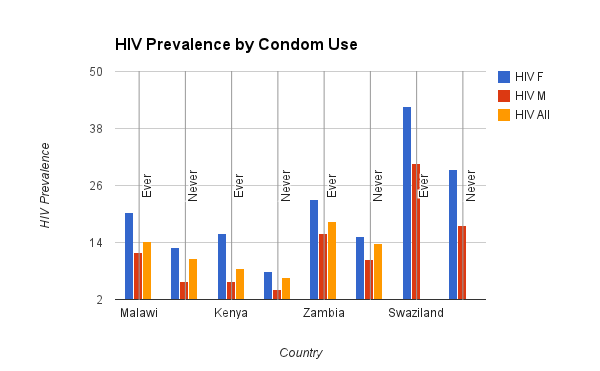
Consider condoms, which are a great technology for reducing unplanned pregnancies, many sexually transmitted infections and sexually transmitted HIV, through anal and vaginal intercourse. But a number of surveys have found that HIV prevalence is very high among those who use condoms. Indeed, prevalence is often higher among those who at least sometimes use condoms than among those who never use them. The following chart is from the relevant Demographic and Health Survey for four countries.

 HIV Prev Condom Use

In some cases, HIV prevalence is 50% higher among those who sometimes use condoms than among those who never use them, sometimes 100%. Shocking? Only if you think HIV transmission in high prevalence African countries is all about sex. Consider another set of figures, this time for condom use at last sexual intercourse in past 12 months. The figures for those who have not had sex in the past 12 months also raise questions (data from DHS surveys). You could suggest that people are not honest, or that people who are infected are ‘abstaining’, but it is far more vital to figure out exactly how people are being infected in order to prevent further infections.

HIV Prev Condom Use 12 Months

Why are HIV prevalence figures so much higher among people who say they sometimes use condoms? I can only tell you what I think; condom use is completely irrelevant to non-sexually transmitted HIV. That sounds obvious, but UNAIDS insist that almost all transmission is through heterosexual sex, yet they stand by figures like these. It is not possible for HIV prevalence to be so much lower among those who never use condoms if almost all HIV transmission is sexual. But there may be an explanation for why those who sometimes use condoms seem so much more likely to be infected.

HIV prevalence is often highest among wealthier, urban dwelling, employed, female, better educated people who live in wealthier countries that have reasonable access to reproductive healthcare services, a relatively low population density and sometimes a higher urban population (but not always). People who answer that description, people who can tick at least some of those boxes (some of the factors are interdependent), it seems, are also more likely to use condoms.

So it is not a case of people with the above characteristics using condoms, yet still being more likely to be infected with HIV, but rather a case of those same people being more likely to be infected with HIV through unsafe healthcare or some other non-sexual route. Once you challenge the sexual behavior paradigm the rest is clear: condoms are irrelevant to non-sexual HIV transmission. It only sounds unintuitive if you keep clinging to the sexist, racist and extremely dangerous reflex about sexual behavior, so beloved by UNAIDS, WHO, CDC, PEPFAR, the Gates Foundation and various universities that have been prominent in the HIV industry.

Given what we so often hear about HIV being inextricably linked with poverty, unemployment, lack of education, isolation, poor access to health services, etc, it is worth emphasizing that the virus may often be more closely linked to the opposite of these factors. Of course, all of these factors are abhorrent and it should be the aim of every wealthy country to ensure that such conditions are alleviated. But if HIV is being transmitted through unsafe healthcare and other routes, all healthcare development must be SAFE healthcare, all HIV education must include information about non-sexual transmission, all employment and environments must exclude risks of bloodborne transmission of HIV, as much as possible.

So first we need to recognize that HIV is not solely transmitted through ‘unsafe’ sex and that it can be transmitted, perhaps far more easily, through unsafe healthcare, cosmetic procedures and traditional practices. ABC ‘strategies’ do not work because HIV transmission is not all about sex, not because Africans are too careless, promiscuous or ignorant (or even ‘disempowered’) to follow its patronizing advice. Safe sex has its place, but safe healthcare is a far more urgent issue in high HIV prevalence African countries right now. It’s not condoms that are failing to protect people against HIV, but the intransigence of UNAIDS and the rest of the HIV industry.