Bloodborne HIV: Don't Get Stuck!

Protect yourself from bloodborne HIV during healthcare and cosmetic services

Category Archives: iatrogenic

South Africa Continues to Fail to Reduce HIV Transmission


UNAIDS is strange, perhaps stranger than their numerous UN siblings. They have a single disease as their brief and they have spent 20 years learning next to nothing about it. They keep collecting data about sex, because they insist that HIV is almost always transmitted through unsafe sexual behavior in high prevalence African countries, but nowhere else. They have to shore up their arguments by appealing to prejudices, such as popular beliefs about ‘African’ sexuality, the brutish mentality of African men (yes, all of them) and the pathetic victim status of African women.

So it comes as a bit of a shock to them when they accidentally carry out research that casts doubt on their fondly held prejudices. A paper entitled ‘Sexual relationship power is unexpectedly not associated with unprotected sex in tavern populations in South Africa‘ is a case in point. Of course, alcohol abuse is a terrible social problem in South Africa (and many other countries), and needs to be addressed urgently. So is violence against women, gender based crime and a whole host of other social problems that are endemic in countries with a large proportion of very poor people who live in virtually uninhabitable environments.

UNAIDS is almost as old as South Africa’s epidemic, where prevalence stood at less than 1% in 1990 but rose rapidly to more than 25% over a decade ago and has not dropped below that figure since [I should clarify, these figures are for antenatal clinic attendees, not for the male and female 15-49 year old population, among whom prevalence is 18.8%]. The yearly HIV reports that South Africa shoves out are almost entirely about sexual behavior, with next to nothing about non-sexual transmission of HIV, via unsafe healthcare, cosmetic and traditional practices. I wonder how long it will take before anyone notices that they clearly haven’t even started to understand the worst HIV epidemic in the world.

[For more about sexual transmission risks and HIV prevention, have a look at some estimated risks from various sexual practices.]

What Kind of HIV Risks do Public Sector Employees Face? Sexual? Non-Sexual?


An article in the Arusha Times claims that public sector employees may be more vulnerable to HIV. This is not too surprising because HIV prevalence is higher among employed than unemployed people in Tanzania and a lot of other higher prevalence countries. Prevalence is also higher among urban dwelling people, wealthier people, and various other groups.

But the question is, why is their risk higher, often much higher? One of those cited in the article is said to have urged “married couples to go for tests on their HIV status without any suspicion on who among the two was to blame in case he or she tested positive”. Maybe neither are ‘to blame’. Many HIV positive people are married to or living with only one, HIV negative person. They don’t know how they were infected. However, the HIV industry insists that they were almost definitely infected through unsafe sex. Perhaps public sector employees face non-sexual risks, such as those from unsafe healthcare, traditional or cosmetic practices?

[There have been a number of unexpected infections in infants and young adults in Tanzania in the 1980s and 1990s and these may have been cases of healthcare associated HIV, but they have yet to be investigated.]

US College Students Practice Using Sex in Advertising in Kenya


Some US college students have set up a fake profile on Tinder to “turns flirty conversation into a serious talk about men’s health for the month of June, which is Men’s Health Month in the US”. I’m not sure what that has to do with Kenya, but their work is described as “talking dirty to dirtbags”, so they are certainly in tune with the HIV industry’s ‘all men are bastards, all women are victims’ mentality.

But I thought the US had learned its lesson from other ‘fake’ campaigns; perhaps not.

Uganda Taking UNAIDS’s Propaganda to its Illogical Conclusion


Since HIV first became a media football, various commentators have obsessed about the idea that there are lots of people who deliberately transmit HIV. There were loads of stories about it in the early days, and they still appear every now and again. One of the countries to take this idea most seriously is Uganda, who have created a law that purports to be aimed at people who ‘deliberately’ transmit HIV.

The fact that there are probably very few such people, if any, won’t worry those supporting the passing of the bill. Some of them have got a lot of mileage out of victim blaming, while making no effort whatsoever to reduce HIV transmission, or to reduce any other kind of human suffering.

This bill may have the unintended effect of criminalizing the work of people who work with skin piercing instruments, such as health care workers, traditional practitioners and cosmetic workers, who all may break skin and draw blood every working day, whether deliberately or by accident, and who may inadvertently infect a client with hepatitis, HIV or some other blood born pathogen.

Uganda has failed to establish how HIV is still being transmitted at a rate high enough to keep prevalence at about the same level for over 10 years. Now they are blaming anyone they can think of rather than reconsidering the epidemic in their country. Perhaps receiving global attention for speaking openly about the virus in the early days counted as doing something then, but now, after nearly three decades of continuing high rates of transmission, being open is not enough.

It’s time to investigate infections, trace partners and, more importantly, to investigate non-sexual risks, such as those people face when visiting health facilities, traditional and cosmetic practitioners. Being open about HIV means being open about how the virus is spread, rather than continuing to rant on about individual sexual behavior. That cash cow is drying up, anyhow, so now is a good time for this weaning process to begin.

[For more about non-sexual HIV risks, visit our Healthcare Risks and Cosmetic Risks for HIV]

It’s not Condoms that are Failing to Protect Against HIV, it’s UNAIDS


At the beginning of this month, David Gisselquist took a careful look at UNAIDS’ ‘Modes of Transmission’ model and found it seriously lacking, grossly overestimating HIV transmission among couples in long term relationships in Malawi. As a result of this flaw, the model gives results which appear to support the extremely racist view that most Africans in high HIV prevalence countries, male and female, engage in a lot of unsafe sex, and mainly sex with people other than their partners.

David shows how the Modes of Transmission model currently estimates that 81% of Malawi’s 95,000 new HIV infections were accounted for by spousal transmission. If you remove the flaw, the percentage goes down to 20%, leaving 60% of all infections unaccounted for by the model (non-sexual transmissions from mother to child make up much of the remainder). How were all those other people infected, including the women who are said to have infected their babies?

It is very likely that a substantial number of HIV infections in Malawi and other high prevalence countries are a result of non-sexual transmission, such as through unsafe healthcare, cosmetic procedures and traditional practices. The much lauded ‘ABC’ (Abstain, Be faithful, use Condoms) approach to HIV prevention does not work, not because many Africans actually live up to the stereotypical ‘all men are bastards, all women are hapless victims’, but because HIV is not always transmitted through heterosexual sex.

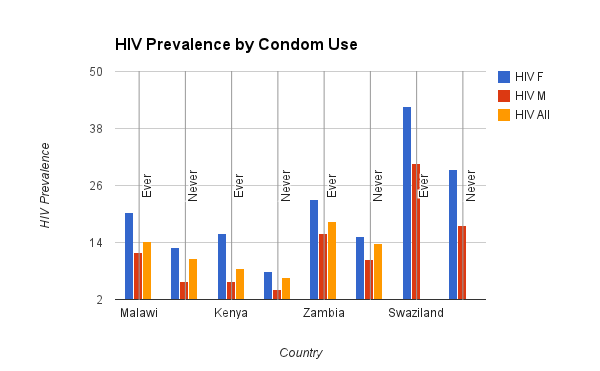
Consider condoms, which are a great technology for reducing unplanned pregnancies, many sexually transmitted infections and sexually transmitted HIV, through anal and vaginal intercourse. But a number of surveys have found that HIV prevalence is very high among those who use condoms. Indeed, prevalence is often higher among those who at least sometimes use condoms than among those who never use them. The following chart is from the relevant Demographic and Health Survey for four countries.

 HIV Prev Condom Use

In some cases, HIV prevalence is 50% higher among those who sometimes use condoms than among those who never use them, sometimes 100%. Shocking? Only if you think HIV transmission in high prevalence African countries is all about sex. Consider another set of figures, this time for condom use at last sexual intercourse in past 12 months. The figures for those who have not had sex in the past 12 months also raise questions (data from DHS surveys). You could suggest that people are not honest, or that people who are infected are ‘abstaining’, but it is far more vital to figure out exactly how people are being infected in order to prevent further infections.

HIV Prev Condom Use 12 Months

Why are HIV prevalence figures so much higher among people who say they sometimes use condoms? I can only tell you what I think; condom use is completely irrelevant to non-sexually transmitted HIV. That sounds obvious, but UNAIDS insist that almost all transmission is through heterosexual sex, yet they stand by figures like these. It is not possible for HIV prevalence to be so much lower among those who never use condoms if almost all HIV transmission is sexual. But there may be an explanation for why those who sometimes use condoms seem so much more likely to be infected.

HIV prevalence is often highest among wealthier, urban dwelling, employed, female, better educated people who live in wealthier countries that have reasonable access to reproductive healthcare services, a relatively low population density and sometimes a higher urban population (but not always). People who answer that description, people who can tick at least some of those boxes (some of the factors are interdependent), it seems, are also more likely to use condoms.

So it is not a case of people with the above characteristics using condoms, yet still being more likely to be infected with HIV, but rather a case of those same people being more likely to be infected with HIV through unsafe healthcare or some other non-sexual route. Once you challenge the sexual behavior paradigm the rest is clear: condoms are irrelevant to non-sexual HIV transmission. It only sounds unintuitive if you keep clinging to the sexist, racist and extremely dangerous reflex about sexual behavior, so beloved by UNAIDS, WHO, CDC, PEPFAR, the Gates Foundation and various universities that have been prominent in the HIV industry.

Given what we so often hear about HIV being inextricably linked with poverty, unemployment, lack of education, isolation, poor access to health services, etc, it is worth emphasizing that the virus may often be more closely linked to the opposite of these factors. Of course, all of these factors are abhorrent and it should be the aim of every wealthy country to ensure that such conditions are alleviated. But if HIV is being transmitted through unsafe healthcare and other routes, all healthcare development must be SAFE healthcare, all HIV education must include information about non-sexual transmission, all employment and environments must exclude risks of bloodborne transmission of HIV, as much as possible.

So first we need to recognize that HIV is not solely transmitted through ‘unsafe’ sex and that it can be transmitted, perhaps far more easily, through unsafe healthcare, cosmetic procedures and traditional practices. ABC ‘strategies’ do not work because HIV transmission is not all about sex, not because Africans are too careless, promiscuous or ignorant (or even ‘disempowered’) to follow its patronizing advice. Safe sex has its place, but safe healthcare is a far more urgent issue in high HIV prevalence African countries right now. It’s not condoms that are failing to protect people against HIV, but the intransigence of UNAIDS and the rest of the HIV industry.

Why Swaziland’s Mass Male Circumcision Program Will Fail


Apparently USAID want to spend $24.5m on a mass male circumcision program in Swaziland, aiming to circumcise 150-200k males, including infants and others who are both too young to give their consent, and to be sexually active. There are three women infected for every two men, which makes one wonder why male circumcision is seen as the best way of spending this money. But for reasons best known to themselves, USAID and other institutions really want to spend money on mass male circumcision programs, even though they are destined to fail to reduce HIV transmission to any great extent, and may even increase transmission according to their own research.

The mass male circumcision program in African countries is predicated on almost all HIV transmission being a result of ‘unsafe’ sexual behavior. However, those who do not engage in such behavior will not be protected by circumcision. Researchers collecting figures for the Demographic and Health Survey suggest that some people may not report their sexual activity, which is as true in Swaziland as it is anywhere. But knowing someone is HIV positive does not tell you how they were infected. What about partner tracing? Were their partners tested? What about their non-sexual risks, such as unsafe healthcare, cosmetic and traditional practices? These are not as thoroughly investigated as people’s ‘unsafe’ sexual behavior, but without this information we can not know how they were infected. Even sexually active people are at risk of non-sexual transmission of HIV. Mass male circumcision will fail everyone at risk of being infected with HIV through non-sexual routes.

Aside from the fact that HIV prevalence among circumcised men is not that different from prevalence among uncircumcised men, about one fifth of men and almost one third of women aged 15-49 years are already HIV positive. Exactly how were all these people infected? It’s just assumed (by the HIV industry) that they must have been infected sexually. The 5.2% of women and 2.1% of men found to be HIV positive, but who said they had never had sexual intercourse, were also likely to have been infected by some non-sexual route.

The mothers of 11 out of 50 infants found to be HIV positive were themselves HIV negative, so those infants would have been infected through some other non-sexual route, probably through unsafe healthcare. Mother to child transmission (MTCT) is acknowledged as a non-sexual mode of transmission; it is even assumed when infants and young children are infected. But given the above mentioned findings, this assumption could easily be wrong even in some cases where the mother happens to be infected.

Mass male circumcision was introduced in Swaziland in 2007, targeting HIV negative men between 15-24 years and newborn babies (though it is available to all uncircumcised men). 13.3% of men in urban areas are already circumcised and 6.2% of rural men. Why is the practice less common in rural areas? The reason for the question is that HIV prevalence is higher in urban than rural areas and it would be interesting to know if sexual practices really are substantially different, or if conditions in and access to health services, health seeking behaviors and other, non-sexual circumstances were also different. Not many people would wish to be circumcised in health facilities where practices are unsafe, where they may be infected with the very disease the operation is said to avert.

It is reported that 43% of men between 15-49 years say they want to be circumcised, compared to 54% who say they do not. Saying you want to be circumcised is not the same as actually going ahead with the operation, as various mass male circumcision programs have already found. The use of the term ‘man’ is also suspect. How many children and people in their early to mid teens will also be railroaded into agreeing? Apparently the recruiters go to schools and press-gang whole classes to turn up to be circumcised in Kenya; once a few agree, all the others are afraid to refuse.

Rather pathetically, the Demographic and Health Survey finds that “the relationship between HIV prevalence and circumcision status is not in the expected direction”, meaning that prevalence is higher among circumcised men (21.8%) than uncircumcised men (19.5%), something that has been found in many countries. To be fair, the numbers of circumcised men are not high, so it’s hard to tell if the difference on its own deserves much attention.

A good deal of other potentially useful data about circumcision was collected, but not reported in the DHS Survey. For example, people were asked their reasons for circumcision, whether tradition/religion, health/hygiene, sexual satisfaction, ease of putting on a condom, other and don’t know. I suspect most people would have had it done, voluntarily or otherwise, for traditional or religious reasons because the health/hygiene arguments had yet to be manufactured when this report was completed; the increased sexual satisfaction argument is spurious and was also added in to the repertoire more recently; ease of putting on a condom, also entirely spurious, is relatively recent; one can only imagine what ‘other’ reasons may have been given, and why someone would choose to have a circumcision without knowing the reason, unless they had given in to peer pressure.

The Global Burden of Disease Report for Swaziland finds that HIV is the top cause of premature death in 2010, accounting for 41% of years of life lost, 341 per 1,000, an increase of 1,625% on the 1990 figures. But syphilis, which stood at number 7 in 1990, accounting for 3% of years of life lost, is no longer in the top 25. It fell further than any other disease over the 20 year period. Why is an easy to transmit infection like syphilis dropping in prevalence in a population said by the HIV industry to engage in high enough levels of ‘unsafe’ sexual behavior to result in the highest HIV prevalence in the world?

The list of reasons why mass male circumcision will fail, as will any other ‘intervention’ predicated on HIV being almost entirely sexually transmitted, goes on. Many people, probably a majority, only have one sexual partner; only a few have many. Most people don’t engage in ‘higher risk’ sex, though some do. Many people ‘take precautions’, though not enough. Factors such as residence, employment status, education level and wealth quintile are often said to determine people’s sexual behavior, but they also determine their health, health seeking behavior and many other things.

Even the sexual behavior data frequently contradicts assumptions about HIV being sexually transmitted. Among women, HIV prevalence is far higher for those who have ever used condoms (42.7%) than those who have never used them (29.4%). Among men too, prevalence is higher for those who have ever used condoms (30.7%) than those who have never used them (17.6%). Condoms protect against sexually transmitted HIV, not non-sexually transmitted HIV, a subtlety apparently lost on proponents of the sexual paradigm, and mass male circumcision programs.

Despite the best efforts of the HIV industry to find one, there is no unified theory of HIV transmission. It is not all transmitted through heterosexual sex and it is not all transmitted through non-sexual routes. The problem is, we don’t know what proportion is transmitted through sex and what proportion is transmitted through non-sexual routes. Some prevention interventions may work if guided by accurate data about how people are infected with HIV, which people and where. But in the absence of that data the bulk of transmissions will remain unaddressed. Mass male circumcision programs are not even vaguely targeted and only address sexual transmission, so they are irrelevant to the majority of people.
Absurd and stigmatizing estimates about how most adults in Malawi get HIV


The WHO and UNAIDS promote their Modes of Transmission model[1] to estimate numbers of HIV infections that adults get from various risks. The model has a simple mistake in its design – causing anyone who uses it to overlook crucial data on HIV in married couples and leading thereby to grossly inflated estimates of numbers of HIV infections acquired from spouses.[2,3]

Several experts recently used WHO’s and UNAIDS’s Modes of Transmission model to identify important risks in Malawi’s HIV epidemic. Their published results[4] provide another illustration of ridiculous, stigmatizing, and anti-family estimates produced by the model. Here’s the gist of what they conclude: Infections from spouses account for 81% of new HIV infections in Malawi (76,688 out of an estimated total of 94,455 infections; see Table).

Simple logic says this is absurd, even without looking at any evidence or data: The number of people getting HIV from their spouses cannot exceed the number of spouses bringing HIV into their families (from any source, such as unsafe health care or non-spousal sex partner). This is logically necessary year-by-year in an epidemic, such as Malawi’s, that has been more or less stable over time. Furthermore, a large percentage of people who are married and HIV-positive die without ever infecting their spouses. So the number of new infections coming from spouses will be much less than half of all new infections.

But that’s not what the model says. Where’s the problem?

The model starts out OK: Using data for 2007, the model finds 2,095,000 married men and 2,497,000 married women (roughly 20% of women were in polygamous marriages).[4] Next, using data from Malawi’s 2004 national Demographic and Health Survey,[5] the model recognizes that more than 10% of married men and women were HIV-positive. So far so good.

But then the model falls off the rails. It assumes that almost all HIV-positive married adults were a risk to infect their spouses. This ignores the well-documented fact that many people who are married and HIV-positive have partners who are also HIV-positive – no one is going to infect anyone in such couples. According to the same 2004 national survey, only 4% of married men in Malawi were at risk to get HIV from their wives (that is, 4% were HIV-negative with an HIV-positive wife), and only 5.7% of married women were at risk to get HIV from their husbands.

Table 1: Estimated number of HIV infections acquired from spouses

Model, risk category for married adults Number of married men Number of married women Model’s estimated number of infections from spouses
Estimates from the Modes of Transmission model (see reference 4)
People who are mutually monogamous 882,000 1,284,000 34,673
Married people who have casual partners 589,000 222,000
People whose spouses have casual partners 222,000 589,000 25,023
Clients of sex worker and wives of such men 388,000 388,000 16,978
 Men who have sex with men and wives of such men 14,000 14,000 14
Total married adults and total estimated infections from spouses according to the Modes of Transmission model 2,095,000 2,497,000 76,688
Alternate estimate recognizing that most HIV-positive married adults have HIV-positive spouses
Total married adults (from Modes of Transmission model) 2,095,000 2,497,000
Married and at risk to get HIV from a spouse (4% of married men, 5.7% of married women; see table12.10 in reference 5) 84,000 142,000
Estimated new infections (assuming a 6.6% annual rate of HIV transmission from wives to husbands and 9.9% from husbands to wives; see reference 2) 5,500 13,500 19,000

Thus, only 226,000 married adults (4% of husbands and 5.7% of wives) were at risk to get HIV from their spouses (see next to last row in the Table). How many of these 226,000 will get HIV from their spouses in a year? During the 1990s, 5 studies in Africa followed discordant couples (only one spouse HIV-positive) to watch HIV transmission from one to the other – distressingly, these studies did not routinely warn participants that they or their partner was infected. With few couples taking care to avoid transmission, 6.6% of HIV-positive wives infected husbands in a year, and 9.5% of HIV-positive husbands infected wives in a year (these rates are from a recent review [2]). With these rates of transmission, 226,000 HIV-positive married men and women in Malawi infected an estimated 19,000 spouses in 2007 – only 20% of the estimated 94,454 new HIV infections in Malawi in 2007.

The Modes of Transmission model’s gross and logically absurd overestimate of numbers of HIV infections from spouses is not harmless. Consider these damaging consequences:

1. Diverting attention from HIV risk in unsafe health care: If sex in marriage accounts for only 20% of new HIV infections instead of 81% as estimated by the Modes of Transmission model, then most infections need to be explained by other risks. What are those other risks? The Modes of Transmission model estimates that all non-spousal sex – casual, commercial, and male-male sex – accounts for a combined total of only 18% of infections. If all sexual risks account for only 38% of infections – 20% from spouses and 18% from other sex partners – what non-sexual risks account for the remaining 62% of infections? The Modes of Transmission model avoids this question by grossly overestimating numbers of HIV infections from spouses.

2. Stigmatizing HIV-positive adults: The estimate produced by the Modes of Transmission model – that sex accounts for more than 99% of HIV infections among adults – stigmatizes all HIV-positive adults with the charge they got it from sex. Publishing such estimates contributes to what could be considered a form of sexual abuse – spouses, relatives, and others accusing people of sexual behavior for which there is no evidence. The estimate coincides with racist stereotypes of sexual behavior, which protect it from critical review.

3. Undermining families: Stigmatizing all HIV-positive adults with the charge they got if from sex breeds suspicion among married adults when one or both learn they and/or their partner are HIV-positive. Lack of trust between spouses weakens families and harms children.

The motivation for such misinformation may be traced to a conflict of interest common among health care professionals – who do not want people to know that unsafe health care contributes to Africa’s HIV epidemics. Rather than admitting the obvious (and doing something about it), health care professionals have been blaming victims, insinuating that almost all African adults with HIV got it from sex. The Modes of Transmission model is part of that stigmatizing and racist smear.

References

1. UNAIDS. Modes of Transmission spreadsheet. Geneva: UNAIDS, 2012. Available at: http://www.unaids.org/en/dataanalysis/datatools/incidencebymodesoftransmission/ (accessed 24 April 2014).

2. Gisselquist D. UNAIDS’ Modes of Transmission model misinforms HIV prevention efforts in Africa’s generalized epidemics. Social Science Research Network, 24 August 2013. Available at: http://papers.ssrn.com/sol3/papers.cfm?abstract_id=2315554 (accessed 24 April 2014).

3. Gisselquist D. Misinformation from UNAIDS’ flawed Modes of Transmission model. dontgetstuck, 14 September 2013. Available at: https://dontgetstuck.wordpress.com/2013/09/14/misinformation-from-unaids-flawed-modes-of-transmission-model/ (accessed 24 April 2014).

4. Maleta K, Bowie C. Selecting HIV infection prevention interventions in the mature HIV epidemic in Malawi using the mode of transmission model. BMC Health Services Research 2010; 10: 243. Available at: http://www.biomedcentral.com/content/pdf/1472-6963-10-243.pdf (accessed 22 April 2014). At the end of this article, see the link to Additional file 1: Data sources used to populate the Mode of Transmission model – Malawi 2007.

5. ORC Macro. Malawi Demographic and Health Survey 2004. Calverton: ORC Macro, 2005. Available at: http://dhsprogram.com/pubs/pdf/FR175/FR-175-MW04.pdf (accessed 26 April 2014).

WHO Supports Circumcision Despite What They Know About Injection Safety in Africa?


The World Health Organization’s (WHO) mass male circumcision page states that the operation reduces risk of HIV transmission from females to males (etc), and that they and UNAIDS recommend circumcision as a strategy for HIV prevention, “particularly in settings with high HIV prevalence and low levels of male circumcision”. The claimed maximization of “public health benefit” raises many questions, about compatibility with their current victim blaming and individual responsibility strategy, and also about what can be done in areas with high rates of circumcision and high rates of HIV prevalence (or do they have a policy on foreskin reconstruction?).

But the question I’d like to concentrate on is what WHO means by ‘settings’. If it refers to high HIV prevalence countries, then they must be aware that most HIV epidemics do not follow national or other geographical or political boundaries. Malawi, as mentioned in a previous blog, can be divided into three clusters, two clusters of low HIV prevalence and one of high prevalence. Only the high prevalence cluster has high rates of circumcision. Rwanda, similarly, has three clusters, two of low prevalence and one of high prevalence. Burundi has only one cluster, and that’s the capital city, where most of the country’s HIV positive people reside.

Indeed, high HIV prevalence tends to cluster in cities in most African countries, yet the vast majority of people in most high prevalence countries live in rural areas, where prevalence is often low, sometimes very low. So WHO aims to target up to 80% of males, when most of them can not be said in any useful sense to live in ‘high HIV prevalence settings’. Although HIV epidemics are heterogenous, within as well as between countries, if high prevalence settings refer to anything at all they refer to areas where access to healthcare facilities is high and levels of safety in healthcare facilities are low (for example).

It gets worse because if you look at Burundi and Rwanda’s Demographic and Health surveys (just two examples out of many) you will see that HIV prevalence is higher among Muslim men (mostly circumcised) than men of some of the other (often non-circumcising) denominations; prevalence is lower even among uncircumcised Muslims than circumcised Muslims. Other Demographic and Health Surveys show that HIV prevalence is far higher among Muslim women than among women of other denominations, not just higher than among Muslim men. So, not only does circumcision not always protect men from HIV, it may well have something to do with higher rates of transmission from men to women; this at least merits a bit of investigation, doesn’t it?

What does this have to do with WHO’s (somewhat vague) data on injection safety and healthcare safety, more broadly? Well, in a document on injection safety success stories, the WHO notes that an estimated 25 billion injections are administered annually and that an estimated 70% of them are unnecessary. The report states that “Unsafe practices and the overuse of injections can cause an estimated 32% of Hepatitis B virus, 40% of Hepatitis C virus and 5% of all new HIV (human immunodeficiency virus) infections every single year.” “At least 50% of injections were unsafe in 14 of 19 countries…for which data were available” according to another WHO report.

We don’t know what levels of injection safety are like in WHO ‘priority’ countries for mass male circumcision programs (Botswana, Ethiopia, Kenya, Lesotho, Malawi, Mozambique, Namibia, Rwanda, South Africa, Swaziland, Tanzania, Uganda, Zambia and Zimbabwe). But we may assume, in the absence of data, that high HIV prevalence countries also tend to have higher rates of HIV transmission through unsafe injections. So what is the range of ates? 10%? 20%? The rate would be very low in many Western countries, so it must be fairly high in at least some high HIV prevalence countries to average at 5%. But if we are not told how high rates are, and for which countries, how can ‘priority’ countries even weigh the benefits against the risks? How can WHO, for that matter (yet they do claim benefits, up to “3.4 million new HIV infections” to be averted by 2025, not forgetting savings of US$16.5 billion)?

The 20 million figure that WHO recommends to be circumcised only refers to medical circumcisions (and it doesn’t include children or infants, not yet anyhow), not to all those non-medical circumcisions carried out in unsterile conditions. The number of non-medical circumcisions would be many tens of millions, perhaps even over one hundred million over the course of these mass male circumcision programs (another 11 years to go). What if even just 5% of them were to be infected with HIV through unsafe practices? They won’t be receiving injections, presumably, but one would like to think that WHO approved programs would have higher standards of safety than circumcisions performed in unsterile conditions by non-medically qualified people. Alas, it is difficult to estimate rates of HIV infections through unsafe medical and traditional practices because so little effort has ever been made to collect such data.

WHO and UNAIDS are obsessed with sexual behavior, but reluctant to assess non-sexually transmitted HIV, especially via unsafe injections and unsafe healthcare in general. Yet they are willing to promote mass male circumcision programs to reduce HIV transmission when their own figures suggest that the number of people who risk being infected with HIV through these programs is likely to be far higher than even the most outlandish estimates of infections ‘averted’. Far from being a ‘distraction’ from effective HIV prevention, as some have called it, mass male circumcision programs are likely to transmit several times more infections than they could ever hope to avert.

Mass Male Circumcision: Western Sponsored Institutionalized Racism


Malawi News Agency has put out a fatuous ‘article’ about a journalist who has been duped into being circumcised in an effort to persuade others to follow his ‘example’. This reminds me that about 6 months ago I blogged about a misinformation service called Internews, connected with the rather smug Gates Foundation and the BBC. Internews boasts about being able to ensure that only ‘positive’ coverage of the US Government’s mass male circumcision program in African countries with medium to high HIV prevalence appears on African news sources.

This Malawian journalist was, apparently, persuaded also by the fact that circumcision is said to protect against human papilloma virus (HPV), although the evidence for this is even slimmer than that relating to HIV. More importantly, many African countries are already receiving assistance to vaccinate millions of Africans against HPV (currently being piloted), so why promote mass male circumcision as well? Are they afraid the HPV vaccination will not give as much protection as their promotional literature claims?

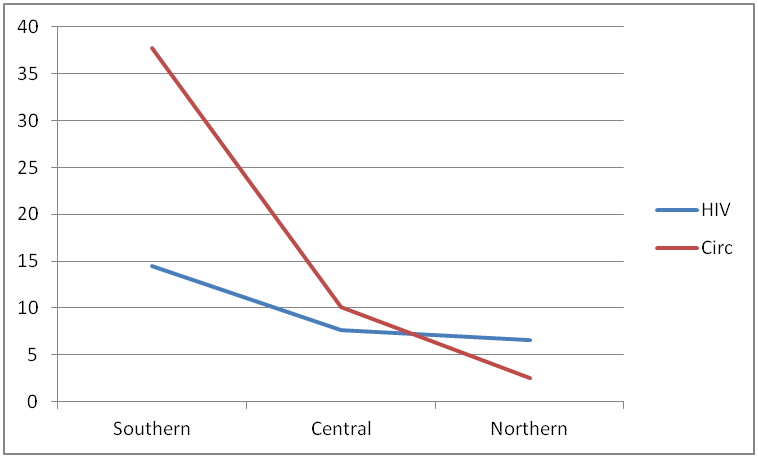
However this journalist was either too innocent, or too well paid off, to check available figures for HIV prevalence among circumcised and uncircumcised men in Malawi. In 2010 HIV prevalence was 14% among circumcised men and only 10% among uncircumcised men. This makes it look as if not being circumcised is protective. But things get a lot worse if you look at the three regions of Malawi, where HIV prevalence and circumcision are very clearly correlated:

Malawi (2)

How much clearer could this be? It is even possible to view these figures for Malawi another way. A 2013 article entitled ‘Mapping HIV clustering: a strategy for identifying populations at high risk of HIV infection in sub-Saharan Africa‘, using the same data (from the 2010 Demographic and Health Survey) identified three major HIV ‘clusters’ in Malawi. The cluster in the North and the one in the center of the country were of relatively low HIV prevalence, where circumcision rates are low. The cluster in the South of the country was of high HIV prevalence, where circumcision rates are high.

Internews and their collaborators would not wish anyone to mention this in a national newspaper, as their express aim is to ensure that only positive coverage about mass male circumcision and HIV transmission sees the light of day; or at least that those who are being told these lies and deceptions don’t know that there are things about circumcision they would be well advised to research. Reading a newspaper that has been bought off by some misinformation service is not research.

The article is full of the usual anecdotal rubbish about mass male circumcision, including some deluded victim of Internews and Co. (also a journalist) who had a problem with penetrative intercourse before being circumcised, the old chestnut about circumcision making people “clean and free of bad odours” (despite making it clear that some of these people suffering from bad odors ‘wear the same underwear for several days), sex being better, etc.

Several times the official claim about mass male circumcision is repeated, that it only ‘gives 60% protection, that people still need to use condoms’ and the usual claptrap. The article even points out that circumcision rates are high in the South and low in the other two regions. But, and this is the clever Internews bit, they don’t bother mentioning that HIV prevalence in the country is highest where circumcision is more widely practiced and lowest where circumcision is less widely practiced.

One of the biggest worries about mass male circumcision is that being circumcised only sometimes appears to be correlated with lower HIV prevalence; just as frequently it appears to be correlated with higher HIV prevalence. Given that there is no known mechanism by which circumcision could protect against HIV infection (only a handful of vague protohypotheses), these differences make it clear that there is a lot more to HIV transmission than circumcision status.

The clear message about mass male circumcision and HIV being payrolled by Internews, Gates Foundation, UNAIDS, PEPFAR and the likes is that Africans are promiscuous, reckless, ignorant and unhygienic; this kind of neo-imperialist institutionalized racism is par for the course in the HIV industry (yes, it is an industry, just like development) and would be condemned as such in most western countries (aside from the US, and perhaps the UK, apparently). So why do we find it acceptable to allow people in high HIV prevalence countries to be systematically deceived?

Avoidable HIV Infection Ignored Because of Refusal to Accept Non-Sexual Transmission


Continuing the theme of my last post, but this time using the 2011 National Antenatal Sentinel HIV & Syphilis Prevalence Survey in South Africa, I again wonder why authors of such reports insist that HIV is almost always transmitted through ‘unsafe’ sexual behavior and fail to say anything about non-sexual modes of transmission.

Disturbingly, the authors note that the “the 2011 report has shown beyond reasonable doubt that there is no significant correlation between HIV and Treponema palladium, the etiological agent for active syphilis, as co-factor for HIV infection.In the 2012 survey we have started to pilot monitoring of Herpes type 2, HHV2, which usually causes genital herpes and is transmitted primarily by direct contact with sores, most often during sexual contact.” This sentiment is echoed on three further occasions in the document.

Rather than suspecting that HIV may sometimes be transmitted through non-sexual routes, such as unsafe healthcare, unsafe cosmetic practices or unsafe traditional practices, they are looking for another sexually transmitted infection to ‘correlate’ with HIV. Why? Or, better still, why not investigate non-sexual routes? There’s plenty of evidence.

South Africa is not the only country to survey syphilis prevalence along with HIV prevalence. Uganda and Zambia also do so, with similar results. Below are radar graphs for all three countries, showing that if syphilis is a proxy for unsafe sexual behavior, HIV does not resemble syphilis very much. This is no surprise, but data continues to be collected and analyzed, before concluding that there is little or no correlation.

South Africa

HIV and Syphilis in South Africa

Uganda

HIV and Syphilis in Uganda

Zambia

HIV and Syphilis in Zambia

How many more years are to be wasted pretending that HIV is almost always transmitted through sexual behavior in high HIV prevalence African countries, but nowhere else? People in high HIV prevalence countries need to be made aware of the non-sexual risks they face. Health facilities, cosmetic facilities and other sites where HIV may be transmitted through contaminated blood or other bodily fluids also need to be made safer. Failing to address lack of knowledge and unsafe non-sexual practices results in an as yet unestimated number of people becoming infected with HIV; these infections are all avoidable.